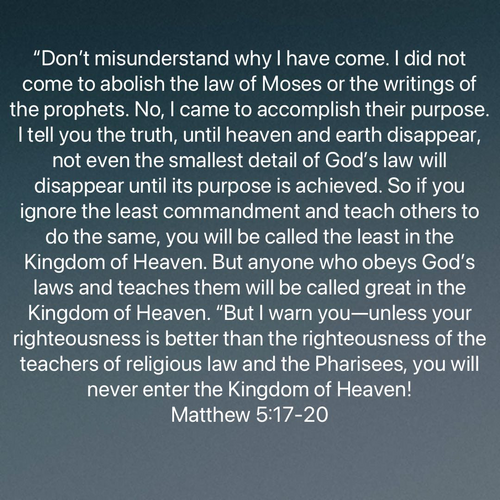
Matthew 5:17-20
Jesus tells us not to misunderstand His purpose in coming. He would not have said this unless there were already people who misunderstood why He had come. Some were even expecting Him to overthrow the Roman government, and when He did not, they rejected Him.
Yet Jesus brings them back to the Word of God and clearly explains that the Law of Moses and the writings of the prophets were still valid. He did not come to abolish the Law or discard it, but to fulfill its purpose. And since the earth is still here, the Word of God remains active and effective. Jesus warned that whoever teaches others to ignore even the least of God’s commandments will be called least in the kingdom of heaven.
I highlight this because some claim the Old Testament is irrelevant today and that our focus should be solely on the New Testament. However, the Old Testament gives us the why of creation and lays the groundwork for understanding our need for a Savior. We were—and in many ways still are—in desperate condition without Jesus. Consider this New Testament passage from 2 Timothy 3:16–17:
“But you must remain faithful to the things you have been taught. You know they are true, for you know you can trust those who taught you. You have been taught the holy Scriptures from childhood, and they have given you the wisdom to receive the salvation that comes by trusting in Christ Jesus. All Scripture is inspired by God and is useful to teach us what is true and to make us realize what is wrong in our lives. It corrects us when we are wrong and teaches us to do what is right. God uses it to prepare and equip his people to do every good work.”
2 Timothy 3:14-17 NLT
When Paul wrote to Timothy about the value of Scripture, he was referring primarily to the Old Testament, since much of the New Testament had not yet been written. Even so, there was already misinformation about Jesus circulating then, just as there is today. Many question the authenticity of the Bible because it was written by human authors. Yet Peter makes the case for the authenticity of the Scriptures when he states:
“Above all, you must realize that no prophecy in Scripture ever came from the prophet’s own understanding, or from human initiative. No, those prophets were moved by the Holy Spirit, and they spoke from God.”
2 Peter 1:20-21 NLT
This truth is foundational. To dismiss or undermine the authenticity of Scripture is to place ourselves on dangerous ground.
Lastly, Jesus makes the startling statement that our righteousness must surpass that of the teachers of religious law and the Pharisees. This was not because they lacked religious activity, but because their righteousness was corrupted by hypocrisy, legalism, and self-righteousness. Their faith was performance-driven, relying on works rather than humility and obedience, and they elevated human traditions above the written Word of God. Jesus confronted these issues repeatedly during His earthly ministry, which explains why He was not welcomed by the religious leaders of His day.
Jesus did not come to lower the standard of God’s Word, but to fulfill it and call His followers to a more authentic righteousness—one rooted in transformational truth, humility, and wholehearted obedience. God’s Word, from beginning to end, remains trustworthy, relevant, and essential for understanding who Jesus is and how we are to live.
Yet Jesus brings them back to the Word of God and clearly explains that the Law of Moses and the writings of the prophets were still valid. He did not come to abolish the Law or discard it, but to fulfill its purpose. And since the earth is still here, the Word of God remains active and effective. Jesus warned that whoever teaches others to ignore even the least of God’s commandments will be called least in the kingdom of heaven.
I highlight this because some claim the Old Testament is irrelevant today and that our focus should be solely on the New Testament. However, the Old Testament gives us the why of creation and lays the groundwork for understanding our need for a Savior. We were—and in many ways still are—in desperate condition without Jesus. Consider this New Testament passage from 2 Timothy 3:16–17:
“But you must remain faithful to the things you have been taught. You know they are true, for you know you can trust those who taught you. You have been taught the holy Scriptures from childhood, and they have given you the wisdom to receive the salvation that comes by trusting in Christ Jesus. All Scripture is inspired by God and is useful to teach us what is true and to make us realize what is wrong in our lives. It corrects us when we are wrong and teaches us to do what is right. God uses it to prepare and equip his people to do every good work.”
2 Timothy 3:14-17 NLT
When Paul wrote to Timothy about the value of Scripture, he was referring primarily to the Old Testament, since much of the New Testament had not yet been written. Even so, there was already misinformation about Jesus circulating then, just as there is today. Many question the authenticity of the Bible because it was written by human authors. Yet Peter makes the case for the authenticity of the Scriptures when he states:
“Above all, you must realize that no prophecy in Scripture ever came from the prophet’s own understanding, or from human initiative. No, those prophets were moved by the Holy Spirit, and they spoke from God.”
2 Peter 1:20-21 NLT
This truth is foundational. To dismiss or undermine the authenticity of Scripture is to place ourselves on dangerous ground.
Lastly, Jesus makes the startling statement that our righteousness must surpass that of the teachers of religious law and the Pharisees. This was not because they lacked religious activity, but because their righteousness was corrupted by hypocrisy, legalism, and self-righteousness. Their faith was performance-driven, relying on works rather than humility and obedience, and they elevated human traditions above the written Word of God. Jesus confronted these issues repeatedly during His earthly ministry, which explains why He was not welcomed by the religious leaders of His day.
Jesus did not come to lower the standard of God’s Word, but to fulfill it and call His followers to a more authentic righteousness—one rooted in transformational truth, humility, and wholehearted obedience. God’s Word, from beginning to end, remains trustworthy, relevant, and essential for understanding who Jesus is and how we are to live.
Recent
Archive
2026
January
Matthew 4:3-11John 1:32-34John 1:45-51John 2:6-11John 2:13-17John 2:18-25John 3:13-17John 3:18-21John 3:27-32, 36John 4:3-10John 4:11-15John 4:16-21John 4:22-26John 4:27-30John 4:31-38John 4:39-42John 4:46-53Mark 1:21-28Matthew 5:1-6Matthew 5:7-12Matthew 5:13-16Matthew 5:17-20Matthew 5:21-26Matthew 5:27-30Matthew 5:31-32
2025
June
July
Psalm 94:1-6Psalm 94:7-11Psalm 94:12-15Psalm 94:16-19Psalm 94:20-23Psalm 95:1-5Psalm 95:6-11Psalm 96:1-6Psalm 96:7-10Psalm 96:11-13Psalm 97:1-9Psalm 97:10-12Psalm 98:1-3Psalm 98:4-9Psalms99:1-5Psalm 99:6-9Psalm 100:1-5Psalm 101:1-8Psalm 102:1-11Psalm 102:12-17Psalm 102:18-28Psalm 103:1-5Psalm 103:6-12Psalm 103:13-18Psalm 103:19-22Psalm 104:1-4Psalm 104.5-9Psalm 104:10-18Psalm 104:19-24Psalm 104:25-32Psalm 104:33-35
Categories
no categories
No Comments