
Romans 9:25-29
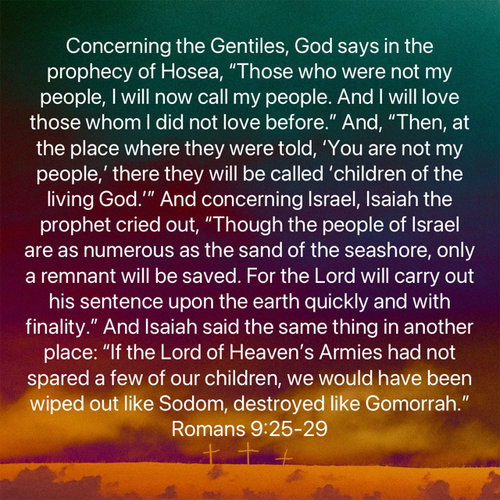
As I read this passage, I feel an incredible sense of gratitude that God made room for the Gentiles, yet at the same time, a profound sense of sorrow for the people of Israel. God is never to be trifled with, and the Israelites learned that lesson the hard way. God means what He says, and He says what He means.
Thankfully, we have a record of their history so that we might learn from their mistakes and, hopefully, avoid falling into the same lapses in judgment. Consider what Paul says concerning the Israelites in 1 Corinthians 10:6–11:
“These things happened as a warning to us, so that we would not crave evil things as they did, or worship idols as some of them did. As the Scriptures say, ‘The people celebrated with feasting and drinking, and they indulged in pagan revelry.’ And we must not engage in sexual immorality as some of them did, causing 23,000 of them to die in one day. Nor should we put Christ to the test, as some of them did and then died from snakebites. And don’t grumble as some of them did, and then were destroyed by the angel of death. These things happened to them as examples for us. They were written down to warn us who live at the end of the age.”
The lessons of history are only valuable if we are willing to learn from them.
Unfortunately, the Gentile nations have not done any better. In fact, we can see some troubling similarities between the spiritual and moral decline of ancient Israel leading up to its destruction by the Babylonian Empire and what is taking place in the United States today. But for the grace of God, where might we find ourselves?
Jonathan Cahn, in his book The Harbinger, along with several others he has written since, draws attention to what he sees as uncanny parallels between ancient Israel and modern America, particularly concerning the warning signs of a nation’s spiritual decline. Whether or not we agree with every parallel, the underlying warning is certainly worth considering.
No nation is exempt from the consequences of turning away from God.
Each generation must make its own choice concerning the Lord. We cannot simply rely upon the faithfulness of those who came before us, nor can we presume upon God’s mercy while continually disregarding His ways.
God is not a respecter of persons, nor does He play favorites. He is absolutely just and honorable in all His ways and decisions, yet abundant in mercy toward those who repent and turn to Him. Was that not His repeated cry throughout the Old Testament? Again and again, He called His people to return to Him, warning them of the consequences of their rebellion while extending His hand of mercy.
The Israelites were given the choice to follow Him, and through Jesus Christ, that invitation has now been extended to the Gentiles as well. In fact, God has done something extraordinary. Through Christ, He has brought Jew and Gentile together into one body, as Paul explains in Ephesians 2:14–16:
“For Christ himself has brought peace to us. He united Jews and Gentiles into one people when, in his own body on the cross, he broke down the wall of hostility that separated us. He did this by ending the system of law with its commandments and regulations. He made peace between Jews and Gentiles by creating in himself one new people from the two groups. Together as one body, Christ reconciled both groups to God by means of his death on the cross, and our hostility toward each other was put to death.”
What an incredible demonstration of God’s grace! What was once divided has been brought together through the sacrifice of Jesus Christ. The invitation to be reconciled to God is no longer limited by nationality, ancestry, or heritage. Through Christ, the door has been opened to all who will come to Him in faith.
Yet, what have we done with this incredible gift? How have we stewarded the knowledge of God in our generation? Are we learning from the mistakes of those who came before us, or are we repeating them under the mistaken assumption that somehow things will turn out differently for us?
God’s mercy should never be mistaken for His approval, nor should His patience be taken for granted. The same God who judged rebellion in generations past is the God who continues to call mankind to repentance today. And thankfully, His heart remains one of mercy toward those who turn to Him.
We all have choices to make, not only for ourselves but also concerning the spiritual legacy we leave to those who follow us.
Choose wisely. Learn from the past. Walk faithfully with God in the present, and diligently pass along His wisdom and truth to the next generation.
After all, the greatest tragedy would not be that we never heard the Good News, but that having heard it, we chose to ignore the incredible gift God has so graciously offered us.
Recent
Archive
2026
January
Matthew 4:3-11John 1:32-34John 1:45-51John 2:6-11John 2:13-17John 2:18-25John 3:13-17John 3:18-21John 3:27-32, 36John 4:3-10John 4:11-15John 4:16-21John 4:22-26John 4:27-30John 4:31-38John 4:39-42John 4:46-53Mark 1:21-28Matthew 5:1-6Matthew 5:7-12Matthew 5:13-16Matthew 5:17-20Matthew 5:21-26Matthew 5:27-30Matthew 5:31-32
February
Matthew 5:33-37Matthew 5:38-42Matthew 5:43-48Matthew 6:1-4Matthew 6:5-13Matthew 6:14-18Matthew 6:19-21Matthew 6:22-23Matthew 6:24-30Matthew 6:31-34Matthew 7:1-5Matthew 7:6Matthew 7:7-11Matthew 7:12Matthew 7:13-14Matthew 7:15-20Matthew 7:21-23Matthew 7:24-29Matthew 8:1-4Matthew 8:5-12Matthew 8:14-17Matthew 8:18-22Matthew 8:23-27Matthew 8:28-34
March
Sunday 3-1-26Luke 7:11-17Mark 5:25-34Mark 5:22-42Matthew 10:1-8Matthew 10:38-40Matthew 11:28-30Matthew 12:33-37Matthew 12:46-50Matthew 10:10-13Mark 4:13-20Matthew 13:36-43Matthew 13:44-46Matthew 13:47-52Matthew 13:53-58Matthew 14:14-21Matthew 14:24-33Matthew 14:34-36John 6:29-35Matthew 5:1-9Matthew 15:10-20Matthew 15:21-28Matthew 15:29-31Matthew 15:32-39Matthew 17:14-20Hebrews 10:24-25Matthew 8:1-6Matthew18:18-20
Categories
no categories
No Comments