
Romans 9:10-16
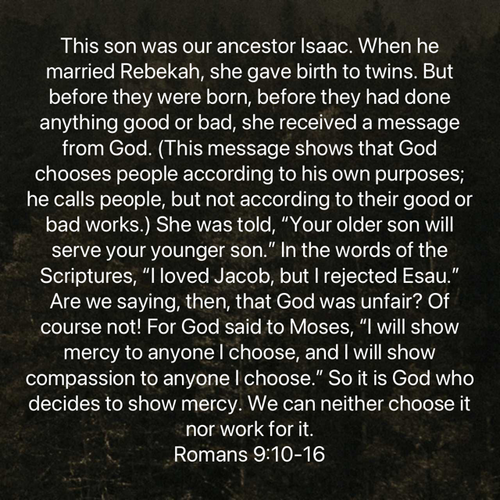
Before I even attempt to make heads or tails out of this portion of Scripture, let me share a couple of other Scriptures to provide some context. After all, we should always allow Scripture to interpret Scripture.
To the prophet Jeremiah, God says:
“The LORD gave me this message: ‘I knew you before I formed you in your mother’s womb. Before you were born I set you apart and appointed you as my prophet to the nations.’”
Jeremiah 1:4–5 NLT
And consider what King David says in Psalm 139:
“You saw me before I was born. Every day of my life was recorded in your book. Every moment was laid out before a single day had passed.”
Psalm 139:16 NLT
As a believer, these two Scriptures have profoundly affected me and helped shape my thoughts on many of the issues we face in our world today. Both speak of God's intimate knowledge of us, His active involvement in our lives, and His purposes for us long before we ever take our first breath.
To Jeremiah, God says, “I knew you”—past tense—even before He formed him in his mother's womb!
Think about that for a moment.
Jeremiah's calling was established before he was even born. God had already appointed him as a prophet to the nations. And what a calling it was!
Jeremiah had it rough. His ministry was marked by opposition, rejection, persecution, and tremendous personal anguish. There were times when he wanted to throw in the towel and walk away from it all. Yet, listen to what he said:
“But if I say I’ll never mention the LORD or speak in his name, his word burns in my heart like a fire. It’s like a fire in my bones! I am worn out trying to hold it in! I can’t do it!”
Jeremiah 20:9 NLT
Jeremiah's calling was great, and as difficult as it was, God knew the man He had chosen for the job. He knew his character, his struggles, his weaknesses, and the resolve that would ultimately keep him going, come hell or high water.
God knows us too.
What really gets me about David's words in Psalm 139 is that he says every day of his life was recorded in God's book before a single day had passed.
Does that not cause us to consider: What is recorded about us?
What does God already know about the days we have yet to live? What purposes has He established for us that we have not yet discovered? What opportunities, challenges, and assignments lie ahead that are already known to Him?
I don't presume to understand the full scope of what these Scriptures reveal about God. After all, we are finite beings trying to comprehend an infinite God. Yet one thing is certain: He knows us far better than we know ourselves.
He knew us before we were born. He knows what we will face tomorrow. He knows our strengths and weaknesses, our victories and failures, and even the choices we have yet to make.
He already knows what we are still finding out about ourselves.
Now, let's bring this back to Jacob and Esau.
Paul tells us that before these two boys were even born, before they had done anything good or bad, God had already determined that His covenantal purposes would continue through Jacob rather than Esau.
Why Jacob? Why not Esau?
We might be tempted to look at their lives and draw our own conclusions. After all, Esau despised his birthright, while Jacob, despite his many shortcomings, valued what Esau was willing to throw away.
Yet Paul makes an important point. God's choice was made before either boy had done anything to earn or deserve it. His purposes were not dependent upon their accomplishments or their merits.
Nevertheless, God knew them both before they were born. He knew the men they would become, the decisions they would make, and the generations that would follow them.
I believe God's foreknowledge is inseparable from His wisdom and His sovereign purposes, even though we may not fully understand how all of that works together.
Consider this: What master builder begins construction without knowing the materials he is working with or the purpose of what he is building?
God is the Master Builder. He sees the completed work before the foundation is ever laid. He knows what we cannot see and understands what we cannot comprehend.
And here is where I believe we need to be careful. Just because God knows our future doesn't mean we understand how His foreknowledge relates to our choices, or that we can explain every decision He makes.
There are mysteries concerning God's sovereignty that we may never fully comprehend this side of eternity.
But there is something wonderfully reassuring in all of this.
Our lives are not an afterthought to God.
We are not random individuals wandering through history, hoping that somehow God will find a use for us. He knew us before we were born, and He has purposes for our lives that are far greater than anything we could accomplish on our own.
The question is whether we are willing to surrender ourselves to those purposes.
Jeremiah could have spent his life resisting his calling, but the Word of God burned within him. David recognized that his days were known to God before he ever lived them. And Paul reminds us that God's purposes stand, not because of human achievement, but because of the One who calls.
Perhaps instead of spending so much time trying to figure out why God does what He does, we should spend more time seeking to understand what He wants to do in and through us.
After all, if He knew us before we were born, surely we can trust Him with the days that lie ahead.
We have much to learn about God. And perhaps one of the greatest things we can learn is to trust the One who knows us completely, even when we don't fully understand His ways.
Recent
Archive
2026
January
Matthew 4:3-11John 1:32-34John 1:45-51John 2:6-11John 2:13-17John 2:18-25John 3:13-17John 3:18-21John 3:27-32, 36John 4:3-10John 4:11-15John 4:16-21John 4:22-26John 4:27-30John 4:31-38John 4:39-42John 4:46-53Mark 1:21-28Matthew 5:1-6Matthew 5:7-12Matthew 5:13-16Matthew 5:17-20Matthew 5:21-26Matthew 5:27-30Matthew 5:31-32
February
Matthew 5:33-37Matthew 5:38-42Matthew 5:43-48Matthew 6:1-4Matthew 6:5-13Matthew 6:14-18Matthew 6:19-21Matthew 6:22-23Matthew 6:24-30Matthew 6:31-34Matthew 7:1-5Matthew 7:6Matthew 7:7-11Matthew 7:12Matthew 7:13-14Matthew 7:15-20Matthew 7:21-23Matthew 7:24-29Matthew 8:1-4Matthew 8:5-12Matthew 8:14-17Matthew 8:18-22Matthew 8:23-27Matthew 8:28-34
March
Sunday 3-1-26Luke 7:11-17Mark 5:25-34Mark 5:22-42Matthew 10:1-8Matthew 10:38-40Matthew 11:28-30Matthew 12:33-37Matthew 12:46-50Matthew 10:10-13Mark 4:13-20Matthew 13:36-43Matthew 13:44-46Matthew 13:47-52Matthew 13:53-58Matthew 14:14-21Matthew 14:24-33Matthew 14:34-36John 6:29-35Matthew 5:1-9Matthew 15:10-20Matthew 15:21-28Matthew 15:29-31Matthew 15:32-39Matthew 17:14-20Hebrews 10:24-25Matthew 8:1-6Matthew18:18-20
Categories
no categories
No Comments