
Matthew 13:36-43
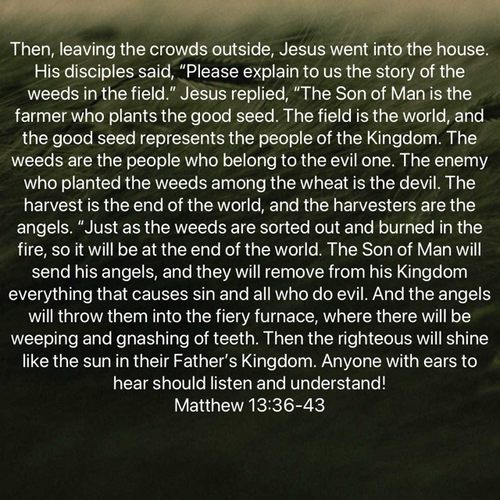
Jesus tells the disciples the Parable of the Wheat and the Weeds, which we can read in Matthew 13:24–29—there is not enough room to include the entire passage here. As He did with the Parable of the Sower and the Seed, Jesus later provides the explanation for this parable.
Parables contain profound wisdom, knowledge, and truth, and their application reaches far beyond the immediate story.
This parable makes it clear that there are enemies among us who can be very difficult to distinguish from the genuine. They have been purposely planted by the devil among the people of God. Jesus tells us elsewhere that we will eventually recognize them by their fruit, but in the early stages wheat and weeds look almost identical. It is nearly impossible to tell the difference. If we try to pull out those we believe to be weeds, we risk uprooting the wheat as well.
New believers still have areas of their lives that God is shaping and refining; in truth, all of us are works in progress. We must be patient and give people the space and time needed for growth. Over time, a person’s true identity becomes evident. That is why Jesus instructs us to let both grow together until the end of the age, when the angels will make the final distinction.
As mentioned, wheat and tares look very much alike at first, and only as they mature can the difference be seen. Eventually the wheat begins to bow under the weight of its grain, while the tares stand upright but remain empty.
True believers become marked by humility and submission to the plan of God, bearing the fruit of kindness, patience, and self-control. In contrast, those who reject Him often remain proud, arrogant, and unchanged. In time, the difference becomes visible, making it clear which is which.
We should also not overlook the sobering words of Jesus: in the end, He will remove everything that causes sin and all who do evil. They will be thrown into the fiery furnace, where there will be weeping and gnashing of teeth. This is not an outcome anyone should desire, yet it is the eventual destiny of those who refuse to bow to Jesus and accept the free gift of salvation. God does not force anyone into hell; people choose that path when they continually reject Him.
These are serious words worthy of deep reflection. A day will come for each of us when we will stand before the King of kings and the Lord of lords.
Are we wheat, or are we tares? Are we bearing good fruit impacting the lives of those around us, or are we standing empty, merely taking up space in the field?
This is a moment that calls for honest self-examination.
Parables contain profound wisdom, knowledge, and truth, and their application reaches far beyond the immediate story.
This parable makes it clear that there are enemies among us who can be very difficult to distinguish from the genuine. They have been purposely planted by the devil among the people of God. Jesus tells us elsewhere that we will eventually recognize them by their fruit, but in the early stages wheat and weeds look almost identical. It is nearly impossible to tell the difference. If we try to pull out those we believe to be weeds, we risk uprooting the wheat as well.
New believers still have areas of their lives that God is shaping and refining; in truth, all of us are works in progress. We must be patient and give people the space and time needed for growth. Over time, a person’s true identity becomes evident. That is why Jesus instructs us to let both grow together until the end of the age, when the angels will make the final distinction.
As mentioned, wheat and tares look very much alike at first, and only as they mature can the difference be seen. Eventually the wheat begins to bow under the weight of its grain, while the tares stand upright but remain empty.
True believers become marked by humility and submission to the plan of God, bearing the fruit of kindness, patience, and self-control. In contrast, those who reject Him often remain proud, arrogant, and unchanged. In time, the difference becomes visible, making it clear which is which.
We should also not overlook the sobering words of Jesus: in the end, He will remove everything that causes sin and all who do evil. They will be thrown into the fiery furnace, where there will be weeping and gnashing of teeth. This is not an outcome anyone should desire, yet it is the eventual destiny of those who refuse to bow to Jesus and accept the free gift of salvation. God does not force anyone into hell; people choose that path when they continually reject Him.
These are serious words worthy of deep reflection. A day will come for each of us when we will stand before the King of kings and the Lord of lords.
Are we wheat, or are we tares? Are we bearing good fruit impacting the lives of those around us, or are we standing empty, merely taking up space in the field?
This is a moment that calls for honest self-examination.
Recent
Archive
2026
January
Matthew 4:3-11John 1:32-34John 1:45-51John 2:6-11John 2:13-17John 2:18-25John 3:13-17John 3:18-21John 3:27-32, 36John 4:3-10John 4:11-15John 4:16-21John 4:22-26John 4:27-30John 4:31-38John 4:39-42John 4:46-53Mark 1:21-28Matthew 5:1-6Matthew 5:7-12Matthew 5:13-16Matthew 5:17-20Matthew 5:21-26Matthew 5:27-30Matthew 5:31-32
February
Matthew 5:33-37Matthew 5:38-42Matthew 5:43-48Matthew 6:1-4Matthew 6:5-13Matthew 6:14-18Matthew 6:19-21Matthew 6:22-23Matthew 6:24-30Matthew 6:31-34Matthew 7:1-5Matthew 7:6Matthew 7:7-11Matthew 7:12Matthew 7:13-14Matthew 7:15-20Matthew 7:21-23Matthew 7:24-29Matthew 8:1-4Matthew 8:5-12Matthew 8:14-17Matthew 8:18-22Matthew 8:23-27Matthew 8:28-34
March
Sunday 3-1-26Luke 7:11-17Mark 5:25-34Mark 5:22-42Matthew 10:1-8Matthew 10:38-40Matthew 11:28-30Matthew 12:33-37Matthew 12:46-50Matthew 10:10-13Mark 4:13-20Matthew 13:36-43Matthew 13:44-46Matthew 13:47-52Matthew 13:53-58Matthew 14:14-21Matthew 14:24-33Matthew 14:34-36John 6:29-35Matthew 5:1-9Matthew 15:10-20Matthew 15:21-28Matthew 15:29-31Matthew 15:32-39Matthew 17:14-20Hebrews 10:24-25Matthew 8:1-6Matthew18:18-20
Categories
no categories
No Comments