
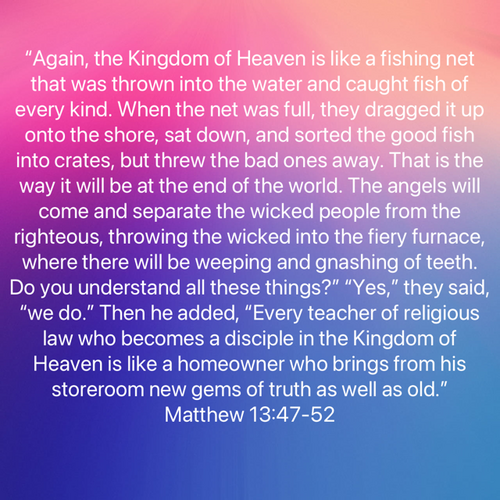
Matthew 13:47-52
Do we live our daily lives mindful of this truth? I am often amazed at the mercy and patience of God in what He allows to go on in this world, knowing that at any moment He could bring everything to its conclusion. At any time, He could say to Jesus and the angels, “It is time.”
Are we ready for that moment? Do we truly understand what that means for us, for those we love, and for the world? This is the question Jesus presented to His disciples.
Have we done what we need to do to prepare for that day? We must live in the present while remaining prepared for the future.
Notice that the fishing net is cast, catching fish of every kind. The Gospel message is for everyone, yet the question remains: who will respond?
Jesus’ final statement in this passage is interesting. He explains that a teacher of religious law who becomes a disciple in the Kingdom of Heaven is like a homeowner who brings from his storeroom both new treasures and old.
This suggests that simply being a teacher of religious law does not necessarily mean someone is a disciple of the Kingdom. Jesus makes a clear distinction. Yet how much more effective a teacher becomes when they are able to draw from both the old and the new.
Generally speaking, the old tells us the history, the beginning, and what has preceded where we are today. It teaches us the why—why we are here and how things came to be. The new, however, is living, breathing, and unfolding. It relies on the old for its foundation and guidance while stepping into what is still unknown to us. The past is a valuable tool in helping us make wise decisions today.
Spiritually speaking, having an understanding of the Old Testament, coupled with the revelation found in the New Testament, is a great gift. Jesus demonstrated this masterfully in His teaching, as we would expect. Paul also used this approach effectively. He often began with what people already knew—the old—and then moved to the new, showing how what came before pointed forward to what was being revealed.
Peter did something similar in his well-known sermon on the day of Pentecost when thousands responded to the message. He connected what the people were witnessing in that moment with what had been spoken long before by the prophet Joel.
To fully prepare for the future, we must understand the past, recognize its fulfillment in the present, and allow it to guide us forward.
Are we ready for that moment? Do we truly understand what that means for us, for those we love, and for the world? This is the question Jesus presented to His disciples.
Have we done what we need to do to prepare for that day? We must live in the present while remaining prepared for the future.
Notice that the fishing net is cast, catching fish of every kind. The Gospel message is for everyone, yet the question remains: who will respond?
Jesus’ final statement in this passage is interesting. He explains that a teacher of religious law who becomes a disciple in the Kingdom of Heaven is like a homeowner who brings from his storeroom both new treasures and old.
This suggests that simply being a teacher of religious law does not necessarily mean someone is a disciple of the Kingdom. Jesus makes a clear distinction. Yet how much more effective a teacher becomes when they are able to draw from both the old and the new.
Generally speaking, the old tells us the history, the beginning, and what has preceded where we are today. It teaches us the why—why we are here and how things came to be. The new, however, is living, breathing, and unfolding. It relies on the old for its foundation and guidance while stepping into what is still unknown to us. The past is a valuable tool in helping us make wise decisions today.
Spiritually speaking, having an understanding of the Old Testament, coupled with the revelation found in the New Testament, is a great gift. Jesus demonstrated this masterfully in His teaching, as we would expect. Paul also used this approach effectively. He often began with what people already knew—the old—and then moved to the new, showing how what came before pointed forward to what was being revealed.
Peter did something similar in his well-known sermon on the day of Pentecost when thousands responded to the message. He connected what the people were witnessing in that moment with what had been spoken long before by the prophet Joel.
To fully prepare for the future, we must understand the past, recognize its fulfillment in the present, and allow it to guide us forward.
Recent
Archive
2026
January
Matthew 4:3-11John 1:32-34John 1:45-51John 2:6-11John 2:13-17John 2:18-25John 3:13-17John 3:18-21John 3:27-32, 36John 4:3-10John 4:11-15John 4:16-21John 4:22-26John 4:27-30John 4:31-38John 4:39-42John 4:46-53Mark 1:21-28Matthew 5:1-6Matthew 5:7-12Matthew 5:13-16Matthew 5:17-20Matthew 5:21-26Matthew 5:27-30Matthew 5:31-32
February
Matthew 5:33-37Matthew 5:38-42Matthew 5:43-48Matthew 6:1-4Matthew 6:5-13Matthew 6:14-18Matthew 6:19-21Matthew 6:22-23Matthew 6:24-30Matthew 6:31-34Matthew 7:1-5Matthew 7:6Matthew 7:7-11Matthew 7:12Matthew 7:13-14Matthew 7:15-20Matthew 7:21-23Matthew 7:24-29Matthew 8:1-4Matthew 8:5-12Matthew 8:14-17Matthew 8:18-22Matthew 8:23-27Matthew 8:28-34
March
Sunday 3-1-26Luke 7:11-17Mark 5:25-34Mark 5:22-42Matthew 10:1-8Matthew 10:38-40Matthew 11:28-30Matthew 12:33-37Matthew 12:46-50Matthew 10:10-13Mark 4:13-20Matthew 13:36-43Matthew 13:44-46Matthew 13:47-52Matthew 13:53-58Matthew 14:14-21Matthew 14:24-33Matthew 14:34-36John 6:29-35Matthew 5:1-9Matthew 15:10-20Matthew 15:21-28Matthew 15:29-31Matthew 15:32-39Matthew 17:14-20Hebrews 10:24-25Matthew 8:1-6Matthew18:18-20
Categories
no categories
No Comments