
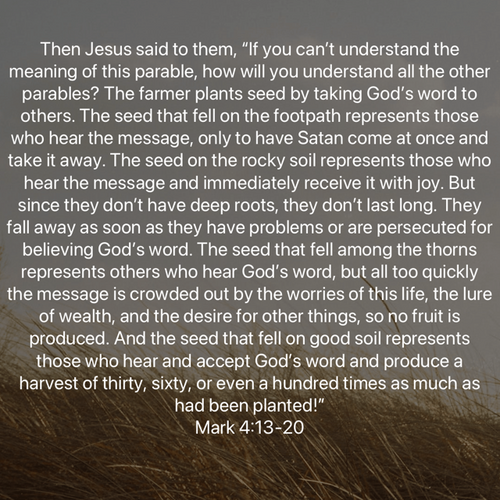
Mark 4:13-20
Jesus often spoke to the crowds in parables. Interestingly, in Matthew’s account (Matthew 13:12), Jesus separates the parable from its explanation with this statement, as we discussed yesterday:
“To those who listen to my teaching, more understanding will be given, and they will have an abundance of knowledge. But for those who are not listening, even what little understanding they have will be taken away from them.”
It seems that we must apply ourselves—spiritual revelation must be sought. Obviously, the meaning of this parable was not immediately apparent to the disciples, and Jesus explained that understanding this parable would help unlock the meaning of the others.
It is somewhat like learning a mathematical principle when the teacher works through the first equation for you.
This parable describes four types of soil that represent people’s hearts and how they receive the Word of God.
The first group hears the Word, but it does not penetrate their hearts. The enemy quickly steals it away, not giving it a chance to take root.
The second group receives the Word with some willingness, but when trials come, they lose their resolve and fall away.
The third group struggles with a love for the things of this world, which ultimately renders the Word ineffective in their lives.
The fourth group, however, receives the Word gladly and multiplies it, increasing their effectiveness.
What this tells me is that we must guard our hearts and keep them open, pliable, full of trust, and free from distraction if we hope to be effective for the Kingdom of God.
“To those who listen to my teaching, more understanding will be given, and they will have an abundance of knowledge. But for those who are not listening, even what little understanding they have will be taken away from them.”
It seems that we must apply ourselves—spiritual revelation must be sought. Obviously, the meaning of this parable was not immediately apparent to the disciples, and Jesus explained that understanding this parable would help unlock the meaning of the others.
It is somewhat like learning a mathematical principle when the teacher works through the first equation for you.
This parable describes four types of soil that represent people’s hearts and how they receive the Word of God.
The first group hears the Word, but it does not penetrate their hearts. The enemy quickly steals it away, not giving it a chance to take root.
The second group receives the Word with some willingness, but when trials come, they lose their resolve and fall away.
The third group struggles with a love for the things of this world, which ultimately renders the Word ineffective in their lives.
The fourth group, however, receives the Word gladly and multiplies it, increasing their effectiveness.
What this tells me is that we must guard our hearts and keep them open, pliable, full of trust, and free from distraction if we hope to be effective for the Kingdom of God.
Recent
Archive
2026
January
Matthew 4:3-11John 1:32-34John 1:45-51John 2:6-11John 2:13-17John 2:18-25John 3:13-17John 3:18-21John 3:27-32, 36John 4:3-10John 4:11-15John 4:16-21John 4:22-26John 4:27-30John 4:31-38John 4:39-42John 4:46-53Mark 1:21-28Matthew 5:1-6Matthew 5:7-12Matthew 5:13-16Matthew 5:17-20Matthew 5:21-26Matthew 5:27-30Matthew 5:31-32
February
Matthew 5:33-37Matthew 5:38-42Matthew 5:43-48Matthew 6:1-4Matthew 6:5-13Matthew 6:14-18Matthew 6:19-21Matthew 6:22-23Matthew 6:24-30Matthew 6:31-34Matthew 7:1-5Matthew 7:6Matthew 7:7-11Matthew 7:12Matthew 7:13-14Matthew 7:15-20Matthew 7:21-23Matthew 7:24-29Matthew 8:1-4Matthew 8:5-12Matthew 8:14-17Matthew 8:18-22Matthew 8:23-27Matthew 8:28-34
March
Sunday 3-1-26Luke 7:11-17Mark 5:25-34Mark 5:22-42Matthew 10:1-8Matthew 10:38-40Matthew 11:28-30Matthew 12:33-37Matthew 12:46-50Matthew 10:10-13Mark 4:13-20Matthew 13:36-43Matthew 13:44-46Matthew 13:47-52Matthew 13:53-58Matthew 14:14-21Matthew 14:24-33Matthew 14:34-36John 6:29-35Matthew 5:1-9Matthew 15:10-20Matthew 15:21-28Matthew 15:29-31Matthew 15:32-39Matthew 17:14-20Hebrews 10:24-25Matthew 8:1-6Matthew18:18-20
Categories
no categories
No Comments