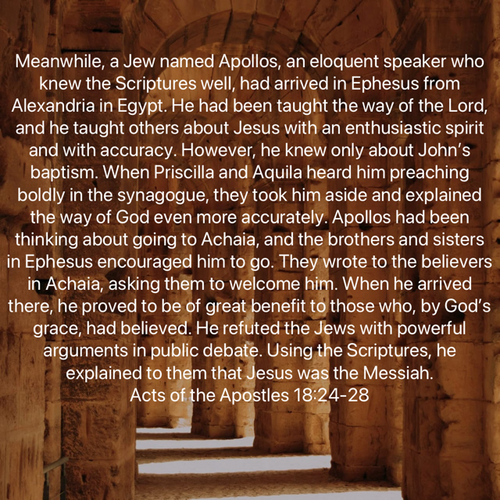
Acts 18:24-28
How can we effectively defend the faith if we don't know the Scriptures? Here we see that Apollos was extremely effective because he knew the Scriptures well. Yet we also see that he was teachable, as he accepted the instruction of Priscilla and Aquila, which is another essential quality in the Kingdom of God. Never think you know it all, because that attitude prevents further learning, and there is always something new to discover.
I feel strongly that it is important to know what you believe—and why. Consider the words of Peter in 1 Peter 3:15:
“Instead, you must worship Christ as Lord of your life. And if someone asks about your hope as a believer, always be ready to explain it.” If someone asked you why you believe in the Lord Jesus, what would you say? What reasons would you give besides, "Because that's what the Bible says"? While that answer is certainly true, God desires us to know Him personally and to understand why we believe what we believe.
The Bible is described as the sword of the Spirit, and a sword is meant to be wielded. In other words, it is a weapon used to destroy faulty arguments. As Paul stated so eloquently:
“We are human, but we don’t wage war as humans do. We use God’s mighty weapons, not worldly weapons, to knock down the strongholds of human reasoning and to destroy false arguments. We destroy every proud obstacle that keeps people from knowing God. We capture their rebellious thoughts and teach them to obey Christ. And after you have become fully obedient, we will punish everyone who remains disobedient.”
2 Corinthians 10:3-6 NLT
With the Word of God, we are able to "knock down the strongholds of human reasoning" and "destroy false arguments." Notice, however, that our battle is not against people—it is against ideas, philosophies, and beliefs that keep people from knowing God. We are not called to destroy people; we are called to dismantle the lies that have taken them captive.
That is why knowing the Scriptures is so important. The enemy has always attacked the truth with deception. In the Garden of Eden, he simply asked, "Did God really say?" Since that day, his strategy has remained remarkably consistent. If he can cause people to doubt God's Word, redefine God's Word, or ignore God's Word, he can lead them away from the God of the Word. The only way to dismantle his lies is with the truth.
Someone who did this masterfully in our day was Charlie Kirk. He would set up speaking events on college campuses and invite people to challenge him publicly on a wide variety of issues. Some people hated him for it, but he understood that truth has nothing to fear from honest examination. He welcomed questions because he had taken the time to study the issues and was prepared to give an answer—and to do so respectfully. Unfortunately, the same could not always be said of those who challenged him. As the saying goes, when people lose the argument, they often resort to name-calling, and many did.
As believers, we should never be afraid of sincere questions. Christianity has withstood two thousand years of scrutiny because it is rooted in truth. Our faith is not blind faith; it is reasonable faith. God has given us historical evidence, fulfilled prophecy, eyewitness testimony, changed lives, and, above all, the living witness of the Holy Spirit. While not everyone will accept the evidence, every believer should be growing in their ability to explain the hope they have in Christ.
The truth is not our enemy—it is what sets us free. Truth is not hate speech, even though our culture increasingly labels it that way. Paul's words to the Galatians seem more relevant today than ever:
"Have I now become your enemy because I am telling you the truth?" (Galatians 4:16)
Truth spoken without love becomes harsh. Love without truth becomes compromise. Jesus demonstrated both perfectly, and we are called to do the same. We should never use the truth as a weapon to wound people, but neither should we blunt its edge to avoid offending them. Our goal is not to win arguments but to win people.
I am reminded again of these wise words I once read: "If someone disagrees with you, don't get upset. If what you believe is true, it will withstand the challenge. If what you believe is false, your friend has done you a favor." That kind of humility keeps us teachable. It allows us to continue growing in our understanding of God's Word while remaining firmly anchored to its truth.
Apollos possessed two qualities that every believer should desire: he knew the Scriptures, and he was willing to learn more. Knowledge without humility produces pride. Humility without knowledge produces instability. But when a teachable heart is joined with a solid understanding of God's Word, God can use that person in powerful ways.
So the question is not simply, "Can I defend my faith?" The greater question is, "Am I humble enough to keep learning?" Like Apollos, are we willing to be shown the way more accurately? Are we teachable? That is the real question.
I feel strongly that it is important to know what you believe—and why. Consider the words of Peter in 1 Peter 3:15:
“Instead, you must worship Christ as Lord of your life. And if someone asks about your hope as a believer, always be ready to explain it.” If someone asked you why you believe in the Lord Jesus, what would you say? What reasons would you give besides, "Because that's what the Bible says"? While that answer is certainly true, God desires us to know Him personally and to understand why we believe what we believe.
The Bible is described as the sword of the Spirit, and a sword is meant to be wielded. In other words, it is a weapon used to destroy faulty arguments. As Paul stated so eloquently:
“We are human, but we don’t wage war as humans do. We use God’s mighty weapons, not worldly weapons, to knock down the strongholds of human reasoning and to destroy false arguments. We destroy every proud obstacle that keeps people from knowing God. We capture their rebellious thoughts and teach them to obey Christ. And after you have become fully obedient, we will punish everyone who remains disobedient.”
2 Corinthians 10:3-6 NLT
With the Word of God, we are able to "knock down the strongholds of human reasoning" and "destroy false arguments." Notice, however, that our battle is not against people—it is against ideas, philosophies, and beliefs that keep people from knowing God. We are not called to destroy people; we are called to dismantle the lies that have taken them captive.
That is why knowing the Scriptures is so important. The enemy has always attacked the truth with deception. In the Garden of Eden, he simply asked, "Did God really say?" Since that day, his strategy has remained remarkably consistent. If he can cause people to doubt God's Word, redefine God's Word, or ignore God's Word, he can lead them away from the God of the Word. The only way to dismantle his lies is with the truth.
Someone who did this masterfully in our day was Charlie Kirk. He would set up speaking events on college campuses and invite people to challenge him publicly on a wide variety of issues. Some people hated him for it, but he understood that truth has nothing to fear from honest examination. He welcomed questions because he had taken the time to study the issues and was prepared to give an answer—and to do so respectfully. Unfortunately, the same could not always be said of those who challenged him. As the saying goes, when people lose the argument, they often resort to name-calling, and many did.
As believers, we should never be afraid of sincere questions. Christianity has withstood two thousand years of scrutiny because it is rooted in truth. Our faith is not blind faith; it is reasonable faith. God has given us historical evidence, fulfilled prophecy, eyewitness testimony, changed lives, and, above all, the living witness of the Holy Spirit. While not everyone will accept the evidence, every believer should be growing in their ability to explain the hope they have in Christ.
The truth is not our enemy—it is what sets us free. Truth is not hate speech, even though our culture increasingly labels it that way. Paul's words to the Galatians seem more relevant today than ever:
"Have I now become your enemy because I am telling you the truth?" (Galatians 4:16)
Truth spoken without love becomes harsh. Love without truth becomes compromise. Jesus demonstrated both perfectly, and we are called to do the same. We should never use the truth as a weapon to wound people, but neither should we blunt its edge to avoid offending them. Our goal is not to win arguments but to win people.
I am reminded again of these wise words I once read: "If someone disagrees with you, don't get upset. If what you believe is true, it will withstand the challenge. If what you believe is false, your friend has done you a favor." That kind of humility keeps us teachable. It allows us to continue growing in our understanding of God's Word while remaining firmly anchored to its truth.
Apollos possessed two qualities that every believer should desire: he knew the Scriptures, and he was willing to learn more. Knowledge without humility produces pride. Humility without knowledge produces instability. But when a teachable heart is joined with a solid understanding of God's Word, God can use that person in powerful ways.
So the question is not simply, "Can I defend my faith?" The greater question is, "Am I humble enough to keep learning?" Like Apollos, are we willing to be shown the way more accurately? Are we teachable? That is the real question.
Recent
Archive
2026
January
Matthew 4:3-11John 1:32-34John 1:45-51John 2:6-11John 2:13-17John 2:18-25John 3:13-17John 3:18-21John 3:27-32, 36John 4:3-10John 4:11-15John 4:16-21John 4:22-26John 4:27-30John 4:31-38John 4:39-42John 4:46-53Mark 1:21-28Matthew 5:1-6Matthew 5:7-12Matthew 5:13-16Matthew 5:17-20Matthew 5:21-26Matthew 5:27-30Matthew 5:31-32
February
Matthew 5:33-37Matthew 5:38-42Matthew 5:43-48Matthew 6:1-4Matthew 6:5-13Matthew 6:14-18Matthew 6:19-21Matthew 6:22-23Matthew 6:24-30Matthew 6:31-34Matthew 7:1-5Matthew 7:6Matthew 7:7-11Matthew 7:12Matthew 7:13-14Matthew 7:15-20Matthew 7:21-23Matthew 7:24-29Matthew 8:1-4Matthew 8:5-12Matthew 8:14-17Matthew 8:18-22Matthew 8:23-27Matthew 8:28-34
March
Sunday 3-1-26Luke 7:11-17Mark 5:25-34Mark 5:22-42Matthew 10:1-8Matthew 10:38-40Matthew 11:28-30Matthew 12:33-37Matthew 12:46-50Matthew 10:10-13Mark 4:13-20Matthew 13:36-43Matthew 13:44-46Matthew 13:47-52Matthew 13:53-58Matthew 14:14-21Matthew 14:24-33Matthew 14:34-36John 6:29-35Matthew 5:1-9Matthew 15:10-20Matthew 15:21-28Matthew 15:29-31Matthew 15:32-39Matthew 17:14-20Hebrews 10:24-25Matthew 8:1-6Matthew18:18-20
Categories
no categories
No Comments