
Acts 15:13-21
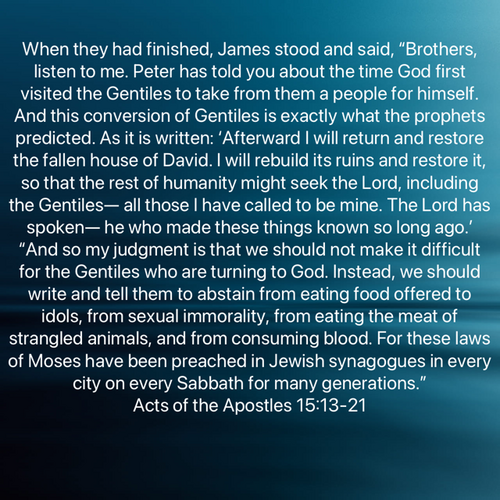
It is neat to see James, the half-brother of Jesus, serving in a leadership role in Jerusalem. It is widely believed that he had become the leader of the Jerusalem church by this time, and his opinion carried great weight among the people. Because of his strict personal devotion to Jewish law, his word on this matter and his acceptance of the Gentile believers carried immense weight, especially among the Jewish skeptics.
James did not always believe. It was not until after the resurrection and a personal visit from the risen Christ that James came to faith. I imagine it was then that the Lord showed James what He would have him do. And here he is, in a pivotal position to make a decision that would affect the future of the church for ages to come. The matter was much bigger than circumcision alone. If this decision had gone another way, it would have set a precedent allowing other “works” to be required for salvation, enslaving people to the Law all over again.
“The sum of Thy word is truth.” (Psalm 119:160)
This is a Scripture that has helped me immensely. It is so easy to take a passage out of context and build a doctrine around it. Why do you think there are so many denominations within the Christian community? It is vitally important to allow Scripture to define other Scriptures and to interpret what is happening around us, as was the case here. James was able to demonstrate how Old Testament prophecy confirmed the very thing they were witnessing at that moment, and it provided direction and clarity to the skeptics during this pivotal time.
The spoken word, backed by the authority of the Scriptures, served to put a period on the subject, though many still grapple with the “works versus grace” debate today.
Closing Thought
One of the greatest safeguards against error is a thorough knowledge of God's Word. James did not rely on personal opinion, tradition, or emotion to settle this dispute. He turned to the Scriptures and allowed God's revealed truth to guide the decision. In a world filled with competing voices and interpretations, believers must continually return to the Word of God as the final authority. When Scripture is viewed as a whole rather than in isolated pieces, it brings clarity, unity, and confidence to our faith.
James did not always believe. It was not until after the resurrection and a personal visit from the risen Christ that James came to faith. I imagine it was then that the Lord showed James what He would have him do. And here he is, in a pivotal position to make a decision that would affect the future of the church for ages to come. The matter was much bigger than circumcision alone. If this decision had gone another way, it would have set a precedent allowing other “works” to be required for salvation, enslaving people to the Law all over again.
“The sum of Thy word is truth.” (Psalm 119:160)
This is a Scripture that has helped me immensely. It is so easy to take a passage out of context and build a doctrine around it. Why do you think there are so many denominations within the Christian community? It is vitally important to allow Scripture to define other Scriptures and to interpret what is happening around us, as was the case here. James was able to demonstrate how Old Testament prophecy confirmed the very thing they were witnessing at that moment, and it provided direction and clarity to the skeptics during this pivotal time.
The spoken word, backed by the authority of the Scriptures, served to put a period on the subject, though many still grapple with the “works versus grace” debate today.
Closing Thought
One of the greatest safeguards against error is a thorough knowledge of God's Word. James did not rely on personal opinion, tradition, or emotion to settle this dispute. He turned to the Scriptures and allowed God's revealed truth to guide the decision. In a world filled with competing voices and interpretations, believers must continually return to the Word of God as the final authority. When Scripture is viewed as a whole rather than in isolated pieces, it brings clarity, unity, and confidence to our faith.
Recent
Archive
2026
January
Matthew 4:3-11John 1:32-34John 1:45-51John 2:6-11John 2:13-17John 2:18-25John 3:13-17John 3:18-21John 3:27-32, 36John 4:3-10John 4:11-15John 4:16-21John 4:22-26John 4:27-30John 4:31-38John 4:39-42John 4:46-53Mark 1:21-28Matthew 5:1-6Matthew 5:7-12Matthew 5:13-16Matthew 5:17-20Matthew 5:21-26Matthew 5:27-30Matthew 5:31-32
February
Matthew 5:33-37Matthew 5:38-42Matthew 5:43-48Matthew 6:1-4Matthew 6:5-13Matthew 6:14-18Matthew 6:19-21Matthew 6:22-23Matthew 6:24-30Matthew 6:31-34Matthew 7:1-5Matthew 7:6Matthew 7:7-11Matthew 7:12Matthew 7:13-14Matthew 7:15-20Matthew 7:21-23Matthew 7:24-29Matthew 8:1-4Matthew 8:5-12Matthew 8:14-17Matthew 8:18-22Matthew 8:23-27Matthew 8:28-34
March
Sunday 3-1-26Luke 7:11-17Mark 5:25-34Mark 5:22-42Matthew 10:1-8Matthew 10:38-40Matthew 11:28-30Matthew 12:33-37Matthew 12:46-50Matthew 10:10-13Mark 4:13-20Matthew 13:36-43Matthew 13:44-46Matthew 13:47-52Matthew 13:53-58Matthew 14:14-21Matthew 14:24-33Matthew 14:34-36John 6:29-35Matthew 5:1-9Matthew 15:10-20Matthew 15:21-28Matthew 15:29-31Matthew 15:32-39Matthew 17:14-20Hebrews 10:24-25Matthew 8:1-6Matthew18:18-20
Categories
no categories
No Comments