
Acts 21:7-14
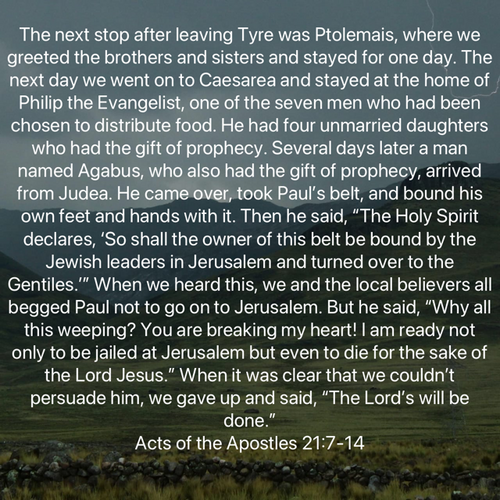
Paul is continuing his farewell tour on his way to Jerusalem. It is interesting that Luke, the author of Acts, makes a point of telling us that Philip’s—not one, but four—daughters all had the gift of prophecy. That seems particularly relevant today, given the debate taking place within certain Christian denominations concerning the role of women in ministry.
In Christ, there is neither Jew nor Greek, slave nor free, male nor female, for we are all one in Christ (Galatians 3:28). If the Holy Spirit gives women the authority to prophesy, how can we say they cannot speak when it involves a pulpit? Where, exactly, were they supposed to prophesy?
As a woman myself, I understand that my husband carries a mantle as the head of our family that I do not carry. Yet I also know that woman was specifically designed by God to be a helper—an ezer. Interestingly, that same Hebrew word is frequently used in the Old Testament to describe God Himself as our Helper. “Helper,” therefore, certainly does not imply inferiority or insignificance. Quite the opposite—it describes someone whose contribution is necessary and valuable.
This is the danger we run into when individual Scriptures are interpreted apart from the whole counsel of God, as I believe has sometimes happened with passages such as 1 Timothy 2:12. Remember, “the sum of Your word is truth” (Psalm 119:160 NASB). In other words, our interpretation of a particular Scripture should be consistent with the rest of Scripture.
If women were continually affirmed by Jesus and women were commended by Paul as valuable coworkers in the Gospel, why would Paul suddenly be issuing a universal command that women must remain silent and never minister publicly? Why would God give Philip’s four daughters the gift of prophecy if they were not permitted to use it? There must have been other factors at play, which a closer examination of the historical and Scriptural context helps illuminate—but that will be a subject for another day.
Not unlike what Paul experienced in Tyre, Agabus, who also had the gift of prophecy, warns Paul about what will happen to him in Jerusalem. As we discussed in yesterday’s post, Paul felt compelled by the Spirit to go, even knowing what awaited him—not unlike Jesus, who knew what awaited Him when He went to Jerusalem.
Sometimes God will lead us into dangerous, uncharted waters for His purposes. His leading does not always take us around difficulty; sometimes it takes us directly through it.
What I do know is that Paul’s imprisonment ultimately served to further the Gospel. At least four of his epistles—Ephesians, Philippians, Colossians, and Philemon—are traditionally known as the Prison Epistles, and depending upon how one understands the circumstances and dating of other letters, additional writings have sometimes been associated with periods of imprisonment.
Nearly two thousand years later, we are still reading words Paul wrote while confined by chains. Rome may have been able to imprison the messenger, but it could not imprison the message.
Talk about a legacy.
In Christ, there is neither Jew nor Greek, slave nor free, male nor female, for we are all one in Christ (Galatians 3:28). If the Holy Spirit gives women the authority to prophesy, how can we say they cannot speak when it involves a pulpit? Where, exactly, were they supposed to prophesy?
As a woman myself, I understand that my husband carries a mantle as the head of our family that I do not carry. Yet I also know that woman was specifically designed by God to be a helper—an ezer. Interestingly, that same Hebrew word is frequently used in the Old Testament to describe God Himself as our Helper. “Helper,” therefore, certainly does not imply inferiority or insignificance. Quite the opposite—it describes someone whose contribution is necessary and valuable.
This is the danger we run into when individual Scriptures are interpreted apart from the whole counsel of God, as I believe has sometimes happened with passages such as 1 Timothy 2:12. Remember, “the sum of Your word is truth” (Psalm 119:160 NASB). In other words, our interpretation of a particular Scripture should be consistent with the rest of Scripture.
If women were continually affirmed by Jesus and women were commended by Paul as valuable coworkers in the Gospel, why would Paul suddenly be issuing a universal command that women must remain silent and never minister publicly? Why would God give Philip’s four daughters the gift of prophecy if they were not permitted to use it? There must have been other factors at play, which a closer examination of the historical and Scriptural context helps illuminate—but that will be a subject for another day.
Not unlike what Paul experienced in Tyre, Agabus, who also had the gift of prophecy, warns Paul about what will happen to him in Jerusalem. As we discussed in yesterday’s post, Paul felt compelled by the Spirit to go, even knowing what awaited him—not unlike Jesus, who knew what awaited Him when He went to Jerusalem.
Sometimes God will lead us into dangerous, uncharted waters for His purposes. His leading does not always take us around difficulty; sometimes it takes us directly through it.
What I do know is that Paul’s imprisonment ultimately served to further the Gospel. At least four of his epistles—Ephesians, Philippians, Colossians, and Philemon—are traditionally known as the Prison Epistles, and depending upon how one understands the circumstances and dating of other letters, additional writings have sometimes been associated with periods of imprisonment.
Nearly two thousand years later, we are still reading words Paul wrote while confined by chains. Rome may have been able to imprison the messenger, but it could not imprison the message.
Talk about a legacy.
Recent
Archive
2026
January
Matthew 4:3-11John 1:32-34John 1:45-51John 2:6-11John 2:13-17John 2:18-25John 3:13-17John 3:18-21John 3:27-32, 36John 4:3-10John 4:11-15John 4:16-21John 4:22-26John 4:27-30John 4:31-38John 4:39-42John 4:46-53Mark 1:21-28Matthew 5:1-6Matthew 5:7-12Matthew 5:13-16Matthew 5:17-20Matthew 5:21-26Matthew 5:27-30Matthew 5:31-32
February
Matthew 5:33-37Matthew 5:38-42Matthew 5:43-48Matthew 6:1-4Matthew 6:5-13Matthew 6:14-18Matthew 6:19-21Matthew 6:22-23Matthew 6:24-30Matthew 6:31-34Matthew 7:1-5Matthew 7:6Matthew 7:7-11Matthew 7:12Matthew 7:13-14Matthew 7:15-20Matthew 7:21-23Matthew 7:24-29Matthew 8:1-4Matthew 8:5-12Matthew 8:14-17Matthew 8:18-22Matthew 8:23-27Matthew 8:28-34
March
Sunday 3-1-26Luke 7:11-17Mark 5:25-34Mark 5:22-42Matthew 10:1-8Matthew 10:38-40Matthew 11:28-30Matthew 12:33-37Matthew 12:46-50Matthew 10:10-13Mark 4:13-20Matthew 13:36-43Matthew 13:44-46Matthew 13:47-52Matthew 13:53-58Matthew 14:14-21Matthew 14:24-33Matthew 14:34-36John 6:29-35Matthew 5:1-9Matthew 15:10-20Matthew 15:21-28Matthew 15:29-31Matthew 15:32-39Matthew 17:14-20Hebrews 10:24-25Matthew 8:1-6Matthew18:18-20
Categories
no categories
No Comments