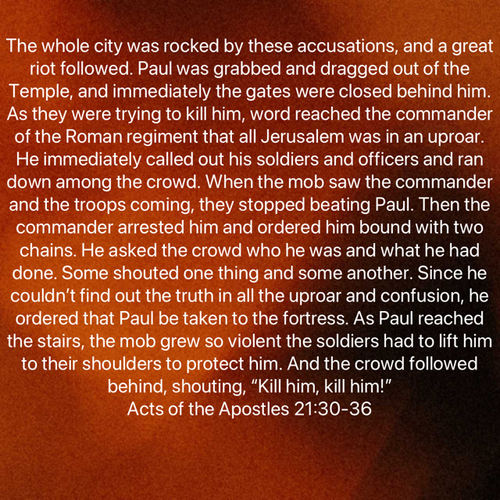
Acts 21:30-36
This reveals the power of a well-placed lie. The enemy is very good at getting people all ramped up for no reason. Paul is minding his own business, finishing a purification ritual, when he gets called out by some Jews from Asia. Now, it doesn’t say they were believing Jews, so I am assuming they were among the group of Jews who had rejected Christ. Their contention was that Paul taught people to ignore Jewish laws, yet here he was observing them. Ironically, they were the ones breaking Jewish law by trying to kill him. This scene is reminiscent of the crowd before Jesus yelling, “Crucify Him!”
Sometimes it is hard for me to grasp how things can go from peaceful to complete chaos in a matter of seconds. My personality is such that it takes a lot for me to get riled up, but there are some personalities that can go from 0 to 100 very quickly. I guess you want that kind of intensity on the battlefield, but anymore, it seems like our streets have become those battlefields. People have taken supposedly “peaceful” protests to a whole new level.
Yet, in the midst of this mob, we can see how law and order can restore calm. Notice that once the commander of the Roman regiment is notified and sends in the soldiers, some measure of order is restored. At the very least, the crowd stops beating Paul.
We need law and order lest things descend into chaos and innocent people get hurt. There are often ringleaders responsible for getting the “sheep” riled up, and once emotion takes over, reason can quickly disappear. Yet society works best when we recognize that there is an Ultimate Authority above every human authority—and that is God. As the Scriptures say in Psalm 33:12 NLT:
“What joy for the nation whose God is the Lord, whose people he has chosen as his inheritance.”
The governing authorities are put in place to maintain order and restrain lawlessness so that society can function. Paul addresses this in Romans 13, describing governing authorities as God’s servants for the purpose of maintaining order and administering justice. But human authority is never ultimate authority. Government functions best when those entrusted with authority recognize that they, too, are accountable to God. When human authority ceases to recognize any authority above itself, the very power intended to restrain evil can itself become oppressive.
That is why Scripture gives us both principles: we are instructed to respect governing authorities, yet when human authority directly contradicts God’s authority, “We must obey God rather than any human authority” (Acts 5:29 NLT).
Just as the Jews had governing laws that they themselves were breaking at this point, so did Rome have laws that governed how its citizens were to be treated. Paul was about to appeal to those Roman laws—which was his right as a Roman citizen, as they were soon to find out.
There is an interesting lesson in all of this. Paul did not have to choose between trusting God and using the legal protections available to him. He could do both. He trusted God as his ultimate Protector while also exercising the rights afforded to him under Roman law. God can work through prayer and supernatural intervention, but He can also work through laws, authorities, courts, and established systems of justice.
Chaos thrives when truth is abandoned, emotions are inflamed, and restraint is removed. But as followers of Christ, we should not be among those who are easily stirred by rumors, accusations, or the passions of a crowd. Before joining the outrage, we should stop and ask: Is this actually true?
The crowd in Jerusalem never stopped long enough to ask that question. Had they done so, they might have discovered that the man they were beating for supposedly disregarding their law was, at that very moment, in the Temple demonstrating his respect for it.
A well-placed lie can start a riot, but a commitment to truth can keep us from becoming part of the mob.
Sometimes it is hard for me to grasp how things can go from peaceful to complete chaos in a matter of seconds. My personality is such that it takes a lot for me to get riled up, but there are some personalities that can go from 0 to 100 very quickly. I guess you want that kind of intensity on the battlefield, but anymore, it seems like our streets have become those battlefields. People have taken supposedly “peaceful” protests to a whole new level.
Yet, in the midst of this mob, we can see how law and order can restore calm. Notice that once the commander of the Roman regiment is notified and sends in the soldiers, some measure of order is restored. At the very least, the crowd stops beating Paul.
We need law and order lest things descend into chaos and innocent people get hurt. There are often ringleaders responsible for getting the “sheep” riled up, and once emotion takes over, reason can quickly disappear. Yet society works best when we recognize that there is an Ultimate Authority above every human authority—and that is God. As the Scriptures say in Psalm 33:12 NLT:
“What joy for the nation whose God is the Lord, whose people he has chosen as his inheritance.”
The governing authorities are put in place to maintain order and restrain lawlessness so that society can function. Paul addresses this in Romans 13, describing governing authorities as God’s servants for the purpose of maintaining order and administering justice. But human authority is never ultimate authority. Government functions best when those entrusted with authority recognize that they, too, are accountable to God. When human authority ceases to recognize any authority above itself, the very power intended to restrain evil can itself become oppressive.
That is why Scripture gives us both principles: we are instructed to respect governing authorities, yet when human authority directly contradicts God’s authority, “We must obey God rather than any human authority” (Acts 5:29 NLT).
Just as the Jews had governing laws that they themselves were breaking at this point, so did Rome have laws that governed how its citizens were to be treated. Paul was about to appeal to those Roman laws—which was his right as a Roman citizen, as they were soon to find out.
There is an interesting lesson in all of this. Paul did not have to choose between trusting God and using the legal protections available to him. He could do both. He trusted God as his ultimate Protector while also exercising the rights afforded to him under Roman law. God can work through prayer and supernatural intervention, but He can also work through laws, authorities, courts, and established systems of justice.
Chaos thrives when truth is abandoned, emotions are inflamed, and restraint is removed. But as followers of Christ, we should not be among those who are easily stirred by rumors, accusations, or the passions of a crowd. Before joining the outrage, we should stop and ask: Is this actually true?
The crowd in Jerusalem never stopped long enough to ask that question. Had they done so, they might have discovered that the man they were beating for supposedly disregarding their law was, at that very moment, in the Temple demonstrating his respect for it.
A well-placed lie can start a riot, but a commitment to truth can keep us from becoming part of the mob.
Recent
Archive
2026
January
Matthew 4:3-11John 1:32-34John 1:45-51John 2:6-11John 2:13-17John 2:18-25John 3:13-17John 3:18-21John 3:27-32, 36John 4:3-10John 4:11-15John 4:16-21John 4:22-26John 4:27-30John 4:31-38John 4:39-42John 4:46-53Mark 1:21-28Matthew 5:1-6Matthew 5:7-12Matthew 5:13-16Matthew 5:17-20Matthew 5:21-26Matthew 5:27-30Matthew 5:31-32
February
Matthew 5:33-37Matthew 5:38-42Matthew 5:43-48Matthew 6:1-4Matthew 6:5-13Matthew 6:14-18Matthew 6:19-21Matthew 6:22-23Matthew 6:24-30Matthew 6:31-34Matthew 7:1-5Matthew 7:6Matthew 7:7-11Matthew 7:12Matthew 7:13-14Matthew 7:15-20Matthew 7:21-23Matthew 7:24-29Matthew 8:1-4Matthew 8:5-12Matthew 8:14-17Matthew 8:18-22Matthew 8:23-27Matthew 8:28-34
March
Sunday 3-1-26Luke 7:11-17Mark 5:25-34Mark 5:22-42Matthew 10:1-8Matthew 10:38-40Matthew 11:28-30Matthew 12:33-37Matthew 12:46-50Matthew 10:10-13Mark 4:13-20Matthew 13:36-43Matthew 13:44-46Matthew 13:47-52Matthew 13:53-58Matthew 14:14-21Matthew 14:24-33Matthew 14:34-36John 6:29-35Matthew 5:1-9Matthew 15:10-20Matthew 15:21-28Matthew 15:29-31Matthew 15:32-39Matthew 17:14-20Hebrews 10:24-25Matthew 8:1-6Matthew18:18-20
Categories
no categories
No Comments