
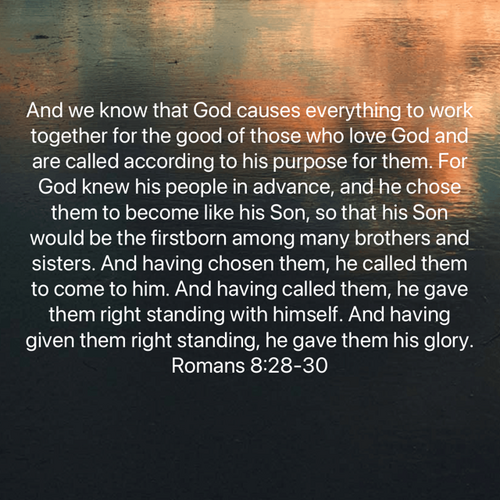
Romans 8:28-30
Interesting portion of Scripture—plenty to unpack!
I am sure we have all heard Romans 8:28 quoted, as we often use that Scripture to encourage one another. Basically, it is all going to work out. God works everything together according to His purposes. I believe that to be true. However, where do we fit into that plan, and are we actively participating in it?
Notice that Scripture doesn't say everything will work together for the good of everyone, but rather, for "those who love God and are called according to His purpose for them."
Those who love God and are called according to His purposes. This brings to mind another Scripture that states, "Many are called, but few are chosen" (Matthew 22:14).
Which leads me to a question: Have we answered His call? Are we among those who have responded to His invitation?
My thought is that life works better when we are walking in step with Him. That doesn't mean we won't experience difficulties, but there is something to be said for cooperating with God's purposes rather than resisting them. Even when we stumble, His grace is sufficient to help us get back on track.
Now, consider this: God knew His people in advance. Hmmmm.
He is God and exists outside the limitations of time. He knows the end from the beginning. He knows those who are His, which also implies that there are those who are not His.
Jesus alluded to this truth in the parable of the Wheat and the Tares. On this particular occasion, Jesus told several parables, yet the disciples specifically asked Him to explain this one.
In Matthew 13:37–43, Jesus explains that the good seed represents the sons of the kingdom, while the tares represent the sons of the evil one. The enemy who sowed them is the devil, and the harvest represents the end of the age, when the angels will separate the wicked from the righteous.
There are so many rabbit holes we could go down concerning this parable, but suffice it to say, not everyone is a "son of the kingdom."
Some are plants, so to speak, sown among the wheat by the enemy. And they can look so much like the real thing that Jesus warns against attempting to uproot them prematurely. Ultimately, God knows those who are His, and the final separation belongs to Him.
In the meantime, Jesus gave us an important principle: We will know them by their fruit.
The challenge is not to be tripped up by those whom Jude describes as hidden reefs in our love feasts.
We have all placed our trust in the wrong people at times, and it really hurts when we get burned. Yet, in hindsight, there were often clues we chose to ignore—whispers of the Holy Spirit, checks in our spirit, or subtle indications that something wasn't quite right.
When we sense those things, it is wise to take note and observe. Guard your heart. Don't become too emotionally invested in relationships where there are legitimate reasons for concern. Give people time to demonstrate their character through their actions.
The enemy is always looking for opportunities to exploit our vulnerabilities and inflict harm. Unfortunately, some people operate without the moral restraints that should govern their behavior, and we can suffer the consequences of placing our trust in them.
Yet I believe that even in those painful experiences, God can teach us valuable lessons. He can sharpen our discernment, expose patterns we previously overlooked, and help us recognize the schemes of our common enemy.
We are called to love everyone, but that doesn't mean we are called to be ignorant!
There is a reason Jesus instructed His disciples to be "wise as serpents and innocent as doves" (Matthew 10:16).
Innocence without wisdom can leave us vulnerable to deception and manipulation. On the other hand, wisdom without innocence can make us suspicious, cynical, and hardhearted. We need both!
Don't fall victim to the enemy's wiles.
I tend to look at Romans 8:28 in light of this truth: There are times when we are going to make mistakes. There are times when we will be taken advantage of because of our own inexperience or misplaced trust. There may even be times when we suffer simply because of someone else's wrongdoing.
Yet none of these experiences places us beyond God's reach.
He is watching over those who belong to Him, and even when He allows us to walk through difficult and painful circumstances, He is able to use those very experiences to accomplish something good in our lives.
Think about Joseph. His brothers meant evil against him, but God used their betrayal to position Joseph for something far greater than he could have imagined.
What the enemy intends for destruction, God can turn into an opportunity for growth, maturity, wisdom, and even blessing.
And perhaps that is one of the greatest assurances we can take from Romans 8:28. Not that everything that happens to us is good, or that we will never experience loss, betrayal, or disappointment, but that God is able to work through all of it for our ultimate good and His eternal purposes.
I have said it many times: God wastes nothing!
Somehow, He takes the beautiful moments, the painful lessons, the victories, the failures, and even the things we wish had never happened, and weaves them together into a beautiful tapestry called our lives.
And the Master Weaver isn't finished yet!
Ps…God's ultimate purpose is to conform us to the image of His Son. Sometimes the "good" He is working toward is not the outcome we hoped for, yet the “person” we are becoming through the experience—is!
Recent
Archive
2026
January
Matthew 4:3-11John 1:32-34John 1:45-51John 2:6-11John 2:13-17John 2:18-25John 3:13-17John 3:18-21John 3:27-32, 36John 4:3-10John 4:11-15John 4:16-21John 4:22-26John 4:27-30John 4:31-38John 4:39-42John 4:46-53Mark 1:21-28Matthew 5:1-6Matthew 5:7-12Matthew 5:13-16Matthew 5:17-20Matthew 5:21-26Matthew 5:27-30Matthew 5:31-32
February
Matthew 5:33-37Matthew 5:38-42Matthew 5:43-48Matthew 6:1-4Matthew 6:5-13Matthew 6:14-18Matthew 6:19-21Matthew 6:22-23Matthew 6:24-30Matthew 6:31-34Matthew 7:1-5Matthew 7:6Matthew 7:7-11Matthew 7:12Matthew 7:13-14Matthew 7:15-20Matthew 7:21-23Matthew 7:24-29Matthew 8:1-4Matthew 8:5-12Matthew 8:14-17Matthew 8:18-22Matthew 8:23-27Matthew 8:28-34
March
Sunday 3-1-26Luke 7:11-17Mark 5:25-34Mark 5:22-42Matthew 10:1-8Matthew 10:38-40Matthew 11:28-30Matthew 12:33-37Matthew 12:46-50Matthew 10:10-13Mark 4:13-20Matthew 13:36-43Matthew 13:44-46Matthew 13:47-52Matthew 13:53-58Matthew 14:14-21Matthew 14:24-33Matthew 14:34-36John 6:29-35Matthew 5:1-9Matthew 15:10-20Matthew 15:21-28Matthew 15:29-31Matthew 15:32-39Matthew 17:14-20Hebrews 10:24-25Matthew 8:1-6Matthew18:18-20
Categories
no categories
No Comments