
Acts 15:6-12
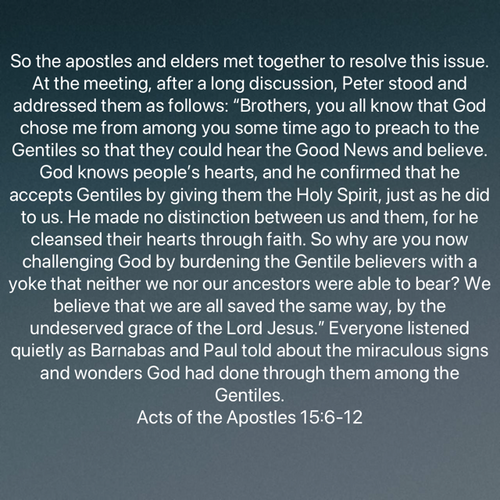
Change never comes easy. As mentioned yesterday, some of the old-school believers were trying to bring the requirements of the Old Covenant—circumcision—into the New Covenant. It became such a significant issue that Paul went with a delegation from Antioch to Jerusalem to seek clarity from the apostles and elders on the matter.
Peter, rightly so, addresses everyone because it was to him that the Lord had given the vision about not calling something unclean that God had made clean, referring to the Gentiles. Again, this was a hard pill for many Jewish believers to swallow because their lives had been completely upended by the Lord. Believing in Jesus, in many cases, meant leaving behind everything they knew, even family, as they would often be shunned by those who did not believe Jesus was the Messiah.
I do not feel that the transition for the Gentiles was quite as earth-shattering, though their lives were certainly changed dramatically as well. When you have believed a certain way your entire life and then a correction, fulfillment, or deeper understanding comes along that changes everything, it can be very unsettling to the foundation of your beliefs.
I hate to say it, but I experienced something similar early in my walk as a Christian while attending a particular denomination that did not believe in certain things that I later came to understand were true. As they say, I received the "left foot of fellowship" and was told, in so many words, that I was getting involved in some bad teaching. This centered around the baptism of the Holy Spirit, which I had experienced, along with praying in tongues.
I remember a conversation with a fellow believer who was concerned and asked why I had not talked to him about it. I replied, "I talked with God about it because I saw it in the Scriptures, and if you have a problem with it, take it up with God, because He is the One who gave it to me."
It is unfortunate that differences in belief can cause separation, but sometimes they do. There is a Scripture that says, "How can two walk together unless they agree?" Speaking of Peter again, I like what he said in 2 Peter 3:14-16:
“And so, dear friends, while you are waiting for these things to happen, make every effort to be found living peaceful lives that are pure and blameless in his sight. And remember, our Lord’s patience gives people time to be saved. This is what our beloved brother Paul also wrote to you with the wisdom God gave him— speaking of these things in all of his letters. Some of his comments are hard to understand, and those who are ignorant and unstable have twisted his letters to mean something quite different, just as they do with other parts of Scripture. And this will result in their destruction.”
Peter is admitting here that even Paul taught things that were difficult to understand. Yet, as Paul states in Philippians 3:12-16:
“I don’t mean to say that I have already achieved these things or that I have already reached perfection. But I press on to possess that perfection for which Christ Jesus first possessed me. No, dear brothers and sisters, I have not achieved it, but I focus on this one thing: Forgetting the past and looking forward to what lies ahead, I press on to reach the end of the race and receive the heavenly prize for which God, through Christ Jesus, is calling us. Let all who are spiritually mature agree on these things. If you disagree on some point, I believe God will make it plain to you. But we must hold on to the progress we have already made.”
Paul acknowledges that he has not arrived at complete understanding or perfection, yet he continues to press forward in his pursuit of Christ. I appreciate his humility here because it reminds us that spiritual growth is a journey. None of us possesses perfect knowledge, and none of us sees every doctrine or issue with complete clarity. We are all learning, growing, and being transformed as we walk with the Lord.
That is why I appreciate what Paul says toward the end of this passage: "If you disagree on some point, I believe God will make it plain to you." What a refreshing perspective. Rather than becoming divisive over every point of disagreement, Paul trusted that God was capable of teaching His people and bringing greater understanding in His timing.
We are going to have disagreements on some points, and that is okay. We are all at different places in our walks with the Lord, and the knowledge of God is cumulative. We must first understand certain foundational truths before we have a basis for understanding the deeper and more mature themes of Scripture. Just as a child must learn addition before tackling algebra, spiritual growth often builds one truth upon another.
The main thing is to hold fast to what we know is true and to build our relationships around those points of agreement rather than majoring on the minors. The essentials of the faith should unite us even when secondary issues may divide our opinions. As we each seek the Lord concerning matters where we disagree, I believe He is faithful to bring greater clarity and understanding.
The believers gathered in Jerusalem were facing a monumental shift in their understanding of God's plan. The question before them was not a minor issue. It touched the very heart of the Gospel itself: Is salvation obtained through faith in Jesus Christ alone, or must it be supplemented by obedience to the Law of Moses? The answer they would arrive at would shape the future of the Church and determine whether the Gospel remained a message of grace or became a burden of works.
We will see that God is not the author of confusion. Through prayer, discussion, testimony, and the leading of the Holy Spirit, clarity will emerge. The same God who guided the early church is still guiding His people today.
Closing Thought
It is important to remain teachable. Sometimes God challenges long-held beliefs, traditions, and assumptions in order to bring us into a fuller understanding of His truth. While we should never compromise on the clear teachings of Scripture, we must also guard against becoming so entrenched in our viewpoints that we are unwilling to consider what God may be revealing through His Word. Humility and a sincere desire for truth are essential ingredients for spiritual growth.
Peter, rightly so, addresses everyone because it was to him that the Lord had given the vision about not calling something unclean that God had made clean, referring to the Gentiles. Again, this was a hard pill for many Jewish believers to swallow because their lives had been completely upended by the Lord. Believing in Jesus, in many cases, meant leaving behind everything they knew, even family, as they would often be shunned by those who did not believe Jesus was the Messiah.
I do not feel that the transition for the Gentiles was quite as earth-shattering, though their lives were certainly changed dramatically as well. When you have believed a certain way your entire life and then a correction, fulfillment, or deeper understanding comes along that changes everything, it can be very unsettling to the foundation of your beliefs.
I hate to say it, but I experienced something similar early in my walk as a Christian while attending a particular denomination that did not believe in certain things that I later came to understand were true. As they say, I received the "left foot of fellowship" and was told, in so many words, that I was getting involved in some bad teaching. This centered around the baptism of the Holy Spirit, which I had experienced, along with praying in tongues.
I remember a conversation with a fellow believer who was concerned and asked why I had not talked to him about it. I replied, "I talked with God about it because I saw it in the Scriptures, and if you have a problem with it, take it up with God, because He is the One who gave it to me."
It is unfortunate that differences in belief can cause separation, but sometimes they do. There is a Scripture that says, "How can two walk together unless they agree?" Speaking of Peter again, I like what he said in 2 Peter 3:14-16:
“And so, dear friends, while you are waiting for these things to happen, make every effort to be found living peaceful lives that are pure and blameless in his sight. And remember, our Lord’s patience gives people time to be saved. This is what our beloved brother Paul also wrote to you with the wisdom God gave him— speaking of these things in all of his letters. Some of his comments are hard to understand, and those who are ignorant and unstable have twisted his letters to mean something quite different, just as they do with other parts of Scripture. And this will result in their destruction.”
Peter is admitting here that even Paul taught things that were difficult to understand. Yet, as Paul states in Philippians 3:12-16:
“I don’t mean to say that I have already achieved these things or that I have already reached perfection. But I press on to possess that perfection for which Christ Jesus first possessed me. No, dear brothers and sisters, I have not achieved it, but I focus on this one thing: Forgetting the past and looking forward to what lies ahead, I press on to reach the end of the race and receive the heavenly prize for which God, through Christ Jesus, is calling us. Let all who are spiritually mature agree on these things. If you disagree on some point, I believe God will make it plain to you. But we must hold on to the progress we have already made.”
Paul acknowledges that he has not arrived at complete understanding or perfection, yet he continues to press forward in his pursuit of Christ. I appreciate his humility here because it reminds us that spiritual growth is a journey. None of us possesses perfect knowledge, and none of us sees every doctrine or issue with complete clarity. We are all learning, growing, and being transformed as we walk with the Lord.
That is why I appreciate what Paul says toward the end of this passage: "If you disagree on some point, I believe God will make it plain to you." What a refreshing perspective. Rather than becoming divisive over every point of disagreement, Paul trusted that God was capable of teaching His people and bringing greater understanding in His timing.
We are going to have disagreements on some points, and that is okay. We are all at different places in our walks with the Lord, and the knowledge of God is cumulative. We must first understand certain foundational truths before we have a basis for understanding the deeper and more mature themes of Scripture. Just as a child must learn addition before tackling algebra, spiritual growth often builds one truth upon another.
The main thing is to hold fast to what we know is true and to build our relationships around those points of agreement rather than majoring on the minors. The essentials of the faith should unite us even when secondary issues may divide our opinions. As we each seek the Lord concerning matters where we disagree, I believe He is faithful to bring greater clarity and understanding.
The believers gathered in Jerusalem were facing a monumental shift in their understanding of God's plan. The question before them was not a minor issue. It touched the very heart of the Gospel itself: Is salvation obtained through faith in Jesus Christ alone, or must it be supplemented by obedience to the Law of Moses? The answer they would arrive at would shape the future of the Church and determine whether the Gospel remained a message of grace or became a burden of works.
We will see that God is not the author of confusion. Through prayer, discussion, testimony, and the leading of the Holy Spirit, clarity will emerge. The same God who guided the early church is still guiding His people today.
Closing Thought
It is important to remain teachable. Sometimes God challenges long-held beliefs, traditions, and assumptions in order to bring us into a fuller understanding of His truth. While we should never compromise on the clear teachings of Scripture, we must also guard against becoming so entrenched in our viewpoints that we are unwilling to consider what God may be revealing through His Word. Humility and a sincere desire for truth are essential ingredients for spiritual growth.
Recent
Archive
2026
January
Matthew 4:3-11John 1:32-34John 1:45-51John 2:6-11John 2:13-17John 2:18-25John 3:13-17John 3:18-21John 3:27-32, 36John 4:3-10John 4:11-15John 4:16-21John 4:22-26John 4:27-30John 4:31-38John 4:39-42John 4:46-53Mark 1:21-28Matthew 5:1-6Matthew 5:7-12Matthew 5:13-16Matthew 5:17-20Matthew 5:21-26Matthew 5:27-30Matthew 5:31-32
February
Matthew 5:33-37Matthew 5:38-42Matthew 5:43-48Matthew 6:1-4Matthew 6:5-13Matthew 6:14-18Matthew 6:19-21Matthew 6:22-23Matthew 6:24-30Matthew 6:31-34Matthew 7:1-5Matthew 7:6Matthew 7:7-11Matthew 7:12Matthew 7:13-14Matthew 7:15-20Matthew 7:21-23Matthew 7:24-29Matthew 8:1-4Matthew 8:5-12Matthew 8:14-17Matthew 8:18-22Matthew 8:23-27Matthew 8:28-34
March
Sunday 3-1-26Luke 7:11-17Mark 5:25-34Mark 5:22-42Matthew 10:1-8Matthew 10:38-40Matthew 11:28-30Matthew 12:33-37Matthew 12:46-50Matthew 10:10-13Mark 4:13-20Matthew 13:36-43Matthew 13:44-46Matthew 13:47-52Matthew 13:53-58Matthew 14:14-21Matthew 14:24-33Matthew 14:34-36John 6:29-35Matthew 5:1-9Matthew 15:10-20Matthew 15:21-28Matthew 15:29-31Matthew 15:32-39Matthew 17:14-20Hebrews 10:24-25Matthew 8:1-6Matthew18:18-20
Categories
no categories
No Comments