
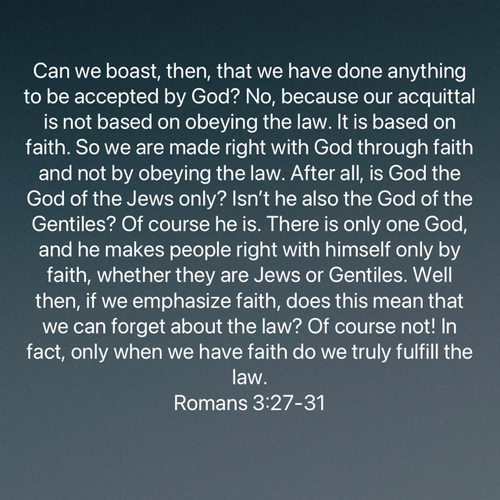
Romans 3:27-31
Many have a tough time with this part of the argument. It is almost too good to be true, so instead, we keep trying to earn our way to heaven. Yet if we could have been good enough, Jesus would not have had to die for us. Let that sink in.
Don’t you think God the Father would have answered Jesus’ prayer—“Take this cup from Me, nevertheless Your will be done, not Mine”—in the Garden of Gethsemane if there had been any other way? That was the problem—there wasn’t.
If the Old Covenant—the Law of Moses—had been enough, and if the blood of bulls and goats had been enough to cleanse us, Jesus would not have had to come. But they weren’t. That’s why those sacrifices had to be repeated again and again, year after year. They were never enough to cleanse us completely before God; instead, they served as a reminder of our sins. Only the blood of the perfect, sinless Lamb would suffice.
Our salvation came at a high price. Jesus willingly paid a price He did not owe for people who could never pay it themselves. That fact reveals the greatness of His love for us. He endured the cross so that we could be reconciled to God and share eternity with Him.
Consider how the author of Hebrews explains this predicament:
“The old system under the law of Moses was only a shadow, a dim preview of the good things to come, not the good things themselves. The sacrifices under that system were repeated again and again, year after year, but they were never able to provide perfect cleansing for those who came to worship. If they could have provided perfect cleansing, the sacrifices would have stopped, for the worshipers would have been purified once for all time, and their feelings of guilt would have disappeared. But instead, those sacrifices actually reminded them of their sins year after year. For it is not possible for the blood of bulls and goats to take away sins. That is why, when Christ came into the world, he said to God, “You did not want animal sacrifices or sin offerings. But you have given me a body to offer. You were not pleased with burnt offerings or other offerings for sin. Then I said, ‘Look, I have come to do your will, O God— as is written about me in the Scriptures.’” First, Christ said, “You did not want animal sacrifices or sin offerings or burnt offerings or other offerings for sin, nor were you pleased with them” (though they are required by the law of Moses). Then he said, “Look, I have come to do your will.” He cancels the first covenant in order to put the second into effect. For God’s will was for us to be made holy by the sacrifice of the body of Jesus Christ, once for all time.” Hebrews 10:1-10 NLT
The author of Hebrews is referencing the prophetic words spoken by David in Psalm 40:6–8. Jesus was their fulfillment, ushering in a New Covenant between God and man.
Yet many still choose to try to approach God through the Old Covenant and obedience to the Law. But the Law itself pointed forward to Christ. Even Moses spoke of One who would come after him and warned the people that they must listen to Him.
“Moses continued, “The LORD your God will raise up for you a prophet like me from among your fellow Israelites. You must listen to him. For this is what you yourselves requested of the LORD your God when you were assembled at Mount Sinai. You said, ‘Don’t let us hear the voice of the LORD our God anymore or see this blazing fire, for we will die.’ “Then the LORD said to me, ‘What they have said is right. I will raise up a prophet like you from among their fellow Israelites. I will put my words in his mouth, and he will tell the people everything I command him. I will personally deal with anyone who will not listen to the messages the prophet proclaims on my behalf.”
Deuteronomy 18:15-19 NLT
Everything that came before—the Old Covenant—was leading to Jesus. The Law and the prophets were pointing toward the One who was to come.
Wow! I don’t presume to understand all of this completely, but I understand it a little better today.
So why the Law in the first place? Because it revealed God’s righteous standard—what He says is right and true. The problem was never with the Law; the problem was with our inability to keep it perfectly. The Law revealed God’s standard, exposed our sin, and ultimately showed us our need for Christ.
Paul says it this way in Galatians:
“Think of it this way. If a father dies and leaves an inheritance for his young children, those children are not much better off than slaves until they grow up, even though they actually own everything their father had. They have to obey their guardians until they reach whatever age their father set. And that’s the way it was with us before Christ came. We were like children; we were slaves to the basic spiritual principles of this world. But when the right time came, God sent his Son, born of a woman, subject to the law. God sent him to buy freedom for us who were slaves to the law, so that he could adopt us as his very own children. And because we are his children, God has sent the Spirit of his Son into our hearts, prompting us to call out, “Abba, Father.” now you are no longer a slave but God’s own child. And since you are his child, God has made you His heir.”
Galatians 4:1-7 NLT
Paul’s illustration helps put all of this into perspective. The Law served a purpose, but it was never the final destination. It pointed us toward something greater—Jesus.
At just the right time, Christ came and did for us what we could never do for ourselves. We went from slaves to sons and daughters, from trying to meet a standard we could never perfectly attain to receiving what Jesus perfectly accomplished on our behalf.
That doesn’t mean God’s standards of right and wrong disappeared. Grace does not make sin acceptable. Rather, God did something far greater—He put His Spirit within us. Now we don’t obey in an attempt to earn our salvation; we desire to obey because we have already received it. We don’t obey so that we can become His children; we obey because we are His children.
This is why trying to earn our salvation misses the entire point of the Gospel. If we could earn it, Jesus would not have needed to purchase it. We could not make ourselves righteous, so He made us righteous through Christ. We could not pay our debt, so Jesus paid it for us.
What part did we play?
We believed and received—no boasting of our own accomplishments. We didn’t earn it, achieve it, or deserve it. We simply received by faith what Jesus accomplished for us.
Perhaps that is why grace can be so difficult for us to comprehend. We are accustomed to earning what we receive. But salvation is different. It is a gift purchased by Someone else at an unimaginable cost and freely offered to us.
The significance of what Jesus did for us can never be overstated. The Old Covenant pointed toward Him. Moses spoke of Him. David prophetically wrote of Him. The sacrifices foreshadowed Him. The Law revealed our need for Him.
And then, at just the right time, He came.
Jesus is not merely part of God’s plan of redemption.
He is the fulfillment of it.
Don’t you think God the Father would have answered Jesus’ prayer—“Take this cup from Me, nevertheless Your will be done, not Mine”—in the Garden of Gethsemane if there had been any other way? That was the problem—there wasn’t.
If the Old Covenant—the Law of Moses—had been enough, and if the blood of bulls and goats had been enough to cleanse us, Jesus would not have had to come. But they weren’t. That’s why those sacrifices had to be repeated again and again, year after year. They were never enough to cleanse us completely before God; instead, they served as a reminder of our sins. Only the blood of the perfect, sinless Lamb would suffice.
Our salvation came at a high price. Jesus willingly paid a price He did not owe for people who could never pay it themselves. That fact reveals the greatness of His love for us. He endured the cross so that we could be reconciled to God and share eternity with Him.
Consider how the author of Hebrews explains this predicament:
“The old system under the law of Moses was only a shadow, a dim preview of the good things to come, not the good things themselves. The sacrifices under that system were repeated again and again, year after year, but they were never able to provide perfect cleansing for those who came to worship. If they could have provided perfect cleansing, the sacrifices would have stopped, for the worshipers would have been purified once for all time, and their feelings of guilt would have disappeared. But instead, those sacrifices actually reminded them of their sins year after year. For it is not possible for the blood of bulls and goats to take away sins. That is why, when Christ came into the world, he said to God, “You did not want animal sacrifices or sin offerings. But you have given me a body to offer. You were not pleased with burnt offerings or other offerings for sin. Then I said, ‘Look, I have come to do your will, O God— as is written about me in the Scriptures.’” First, Christ said, “You did not want animal sacrifices or sin offerings or burnt offerings or other offerings for sin, nor were you pleased with them” (though they are required by the law of Moses). Then he said, “Look, I have come to do your will.” He cancels the first covenant in order to put the second into effect. For God’s will was for us to be made holy by the sacrifice of the body of Jesus Christ, once for all time.” Hebrews 10:1-10 NLT
The author of Hebrews is referencing the prophetic words spoken by David in Psalm 40:6–8. Jesus was their fulfillment, ushering in a New Covenant between God and man.
Yet many still choose to try to approach God through the Old Covenant and obedience to the Law. But the Law itself pointed forward to Christ. Even Moses spoke of One who would come after him and warned the people that they must listen to Him.
“Moses continued, “The LORD your God will raise up for you a prophet like me from among your fellow Israelites. You must listen to him. For this is what you yourselves requested of the LORD your God when you were assembled at Mount Sinai. You said, ‘Don’t let us hear the voice of the LORD our God anymore or see this blazing fire, for we will die.’ “Then the LORD said to me, ‘What they have said is right. I will raise up a prophet like you from among their fellow Israelites. I will put my words in his mouth, and he will tell the people everything I command him. I will personally deal with anyone who will not listen to the messages the prophet proclaims on my behalf.”
Deuteronomy 18:15-19 NLT
Everything that came before—the Old Covenant—was leading to Jesus. The Law and the prophets were pointing toward the One who was to come.
Wow! I don’t presume to understand all of this completely, but I understand it a little better today.
So why the Law in the first place? Because it revealed God’s righteous standard—what He says is right and true. The problem was never with the Law; the problem was with our inability to keep it perfectly. The Law revealed God’s standard, exposed our sin, and ultimately showed us our need for Christ.
Paul says it this way in Galatians:
“Think of it this way. If a father dies and leaves an inheritance for his young children, those children are not much better off than slaves until they grow up, even though they actually own everything their father had. They have to obey their guardians until they reach whatever age their father set. And that’s the way it was with us before Christ came. We were like children; we were slaves to the basic spiritual principles of this world. But when the right time came, God sent his Son, born of a woman, subject to the law. God sent him to buy freedom for us who were slaves to the law, so that he could adopt us as his very own children. And because we are his children, God has sent the Spirit of his Son into our hearts, prompting us to call out, “Abba, Father.” now you are no longer a slave but God’s own child. And since you are his child, God has made you His heir.”
Galatians 4:1-7 NLT
Paul’s illustration helps put all of this into perspective. The Law served a purpose, but it was never the final destination. It pointed us toward something greater—Jesus.
At just the right time, Christ came and did for us what we could never do for ourselves. We went from slaves to sons and daughters, from trying to meet a standard we could never perfectly attain to receiving what Jesus perfectly accomplished on our behalf.
That doesn’t mean God’s standards of right and wrong disappeared. Grace does not make sin acceptable. Rather, God did something far greater—He put His Spirit within us. Now we don’t obey in an attempt to earn our salvation; we desire to obey because we have already received it. We don’t obey so that we can become His children; we obey because we are His children.
This is why trying to earn our salvation misses the entire point of the Gospel. If we could earn it, Jesus would not have needed to purchase it. We could not make ourselves righteous, so He made us righteous through Christ. We could not pay our debt, so Jesus paid it for us.
What part did we play?
We believed and received—no boasting of our own accomplishments. We didn’t earn it, achieve it, or deserve it. We simply received by faith what Jesus accomplished for us.
Perhaps that is why grace can be so difficult for us to comprehend. We are accustomed to earning what we receive. But salvation is different. It is a gift purchased by Someone else at an unimaginable cost and freely offered to us.
The significance of what Jesus did for us can never be overstated. The Old Covenant pointed toward Him. Moses spoke of Him. David prophetically wrote of Him. The sacrifices foreshadowed Him. The Law revealed our need for Him.
And then, at just the right time, He came.
Jesus is not merely part of God’s plan of redemption.
He is the fulfillment of it.
Recent
Archive
2026
January
Matthew 4:3-11John 1:32-34John 1:45-51John 2:6-11John 2:13-17John 2:18-25John 3:13-17John 3:18-21John 3:27-32, 36John 4:3-10John 4:11-15John 4:16-21John 4:22-26John 4:27-30John 4:31-38John 4:39-42John 4:46-53Mark 1:21-28Matthew 5:1-6Matthew 5:7-12Matthew 5:13-16Matthew 5:17-20Matthew 5:21-26Matthew 5:27-30Matthew 5:31-32
February
Matthew 5:33-37Matthew 5:38-42Matthew 5:43-48Matthew 6:1-4Matthew 6:5-13Matthew 6:14-18Matthew 6:19-21Matthew 6:22-23Matthew 6:24-30Matthew 6:31-34Matthew 7:1-5Matthew 7:6Matthew 7:7-11Matthew 7:12Matthew 7:13-14Matthew 7:15-20Matthew 7:21-23Matthew 7:24-29Matthew 8:1-4Matthew 8:5-12Matthew 8:14-17Matthew 8:18-22Matthew 8:23-27Matthew 8:28-34
March
Sunday 3-1-26Luke 7:11-17Mark 5:25-34Mark 5:22-42Matthew 10:1-8Matthew 10:38-40Matthew 11:28-30Matthew 12:33-37Matthew 12:46-50Matthew 10:10-13Mark 4:13-20Matthew 13:36-43Matthew 13:44-46Matthew 13:47-52Matthew 13:53-58Matthew 14:14-21Matthew 14:24-33Matthew 14:34-36John 6:29-35Matthew 5:1-9Matthew 15:10-20Matthew 15:21-28Matthew 15:29-31Matthew 15:32-39Matthew 17:14-20Hebrews 10:24-25Matthew 8:1-6Matthew18:18-20
Categories
no categories
No Comments