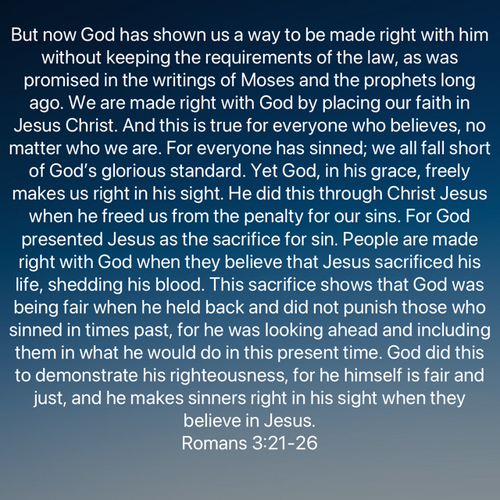
Romans 3:21-26
“But now…” This is where Paul turns the argument from the problem to the answer. We had to understand the problem in order to receive the answer. We needed to understand our lost state before God before we could truly see our need for the Savior—Jesus.
The Law was insufficient to save us. It showed us how we were supposed to live while at the same time revealing our inability to meet all its requirements. As Paul says in verse 23, “For everyone has sinned; we all fall short of God’s glorious standard.”
So what does God do?
In His grace, He freely makes us right in His sight through His Son, Jesus, who paid the penalty for our sin. God did for us what we could never do for ourselves. He provided the way of salvation through faith in His Son.
We are made right with God when we believe that Jesus sacrificed His life, shedding His blood for us. Jesus did this once and for all time. His sacrifice was sufficient for the sins of humanity—past, present, and future. In doing so, God demonstrated both His righteousness and His mercy. He did not simply overlook sin; the penalty for sin was paid through Christ. God is both just and the One who makes sinners right with Himself when they believe in Jesus.
And before you say, “Well, what about those who lived and died before Jesus came to the earth?” consider the following Scriptures that Peter wrote:
“Christ suffered for our sins once for all time. He never sinned, but he died for sinners to bring you safely home to God. He suffered physical death, but he was raised to life in the Spirit. So he went and preached to the spirits in prison— those who disobeyed God long ago when God waited patiently while Noah was building his boat. Only eight people were saved from drowning in that terrible flood. And that water is a picture of baptism, which now saves you, not by removing dirt from your body, but as a response to God from a clean conscience. It is effective because of the resurrection of Jesus Christ.” 1 Peter 3:18-21 NLT
“That is why the Good News was preached to those who are now dead—so although they were destined to die like all people, they now live forever with God in the Spirit.” 1 Peter 4:6 NLT
These are fascinating passages, and Christians have understood some of their details differently through the centuries. Exactly what Peter means when he says Jesus “preached to the spirits in prison,” and precisely what he means when he says the Good News “was preached to those who are now dead,” has been interpreted in several ways.
But the larger truth is clear: no one is saved apart from the work of Jesus Christ. His sacrifice reaches beyond the boundaries of time. Those who lived before the cross were not saved by keeping the Law any more than we are. Salvation has always depended upon the grace of God and ultimately upon the redeeming work of Christ.
That is what makes those two little words—“But now”—so powerful.
Paul has spent nearly three chapters showing us the problem. Jew and Gentile alike are guilty. The Law cannot save us. Our good works cannot save us. Our religious heritage cannot save us. We cannot make ourselves righteous before a holy God.
But now…God has provided the answer.
Jesus.
What we could not earn, God freely gave. What we could not accomplish, Jesus accomplished for us. The righteousness we could never attain through our own efforts is offered to us through faith in Christ.
That leaves every person with a decision. God has provided salvation, but we must respond to Him in faith.
The problem is sin.
The answer is Jesus.
And the choice of what we will do with Him belongs to each one of us.
Choose wisely.
The Law was insufficient to save us. It showed us how we were supposed to live while at the same time revealing our inability to meet all its requirements. As Paul says in verse 23, “For everyone has sinned; we all fall short of God’s glorious standard.”
So what does God do?
In His grace, He freely makes us right in His sight through His Son, Jesus, who paid the penalty for our sin. God did for us what we could never do for ourselves. He provided the way of salvation through faith in His Son.
We are made right with God when we believe that Jesus sacrificed His life, shedding His blood for us. Jesus did this once and for all time. His sacrifice was sufficient for the sins of humanity—past, present, and future. In doing so, God demonstrated both His righteousness and His mercy. He did not simply overlook sin; the penalty for sin was paid through Christ. God is both just and the One who makes sinners right with Himself when they believe in Jesus.
And before you say, “Well, what about those who lived and died before Jesus came to the earth?” consider the following Scriptures that Peter wrote:
“Christ suffered for our sins once for all time. He never sinned, but he died for sinners to bring you safely home to God. He suffered physical death, but he was raised to life in the Spirit. So he went and preached to the spirits in prison— those who disobeyed God long ago when God waited patiently while Noah was building his boat. Only eight people were saved from drowning in that terrible flood. And that water is a picture of baptism, which now saves you, not by removing dirt from your body, but as a response to God from a clean conscience. It is effective because of the resurrection of Jesus Christ.” 1 Peter 3:18-21 NLT
“That is why the Good News was preached to those who are now dead—so although they were destined to die like all people, they now live forever with God in the Spirit.” 1 Peter 4:6 NLT
These are fascinating passages, and Christians have understood some of their details differently through the centuries. Exactly what Peter means when he says Jesus “preached to the spirits in prison,” and precisely what he means when he says the Good News “was preached to those who are now dead,” has been interpreted in several ways.
But the larger truth is clear: no one is saved apart from the work of Jesus Christ. His sacrifice reaches beyond the boundaries of time. Those who lived before the cross were not saved by keeping the Law any more than we are. Salvation has always depended upon the grace of God and ultimately upon the redeeming work of Christ.
That is what makes those two little words—“But now”—so powerful.
Paul has spent nearly three chapters showing us the problem. Jew and Gentile alike are guilty. The Law cannot save us. Our good works cannot save us. Our religious heritage cannot save us. We cannot make ourselves righteous before a holy God.
But now…God has provided the answer.
Jesus.
What we could not earn, God freely gave. What we could not accomplish, Jesus accomplished for us. The righteousness we could never attain through our own efforts is offered to us through faith in Christ.
That leaves every person with a decision. God has provided salvation, but we must respond to Him in faith.
The problem is sin.
The answer is Jesus.
And the choice of what we will do with Him belongs to each one of us.
Choose wisely.
Recent
Archive
2026
January
Matthew 4:3-11John 1:32-34John 1:45-51John 2:6-11John 2:13-17John 2:18-25John 3:13-17John 3:18-21John 3:27-32, 36John 4:3-10John 4:11-15John 4:16-21John 4:22-26John 4:27-30John 4:31-38John 4:39-42John 4:46-53Mark 1:21-28Matthew 5:1-6Matthew 5:7-12Matthew 5:13-16Matthew 5:17-20Matthew 5:21-26Matthew 5:27-30Matthew 5:31-32
February
Matthew 5:33-37Matthew 5:38-42Matthew 5:43-48Matthew 6:1-4Matthew 6:5-13Matthew 6:14-18Matthew 6:19-21Matthew 6:22-23Matthew 6:24-30Matthew 6:31-34Matthew 7:1-5Matthew 7:6Matthew 7:7-11Matthew 7:12Matthew 7:13-14Matthew 7:15-20Matthew 7:21-23Matthew 7:24-29Matthew 8:1-4Matthew 8:5-12Matthew 8:14-17Matthew 8:18-22Matthew 8:23-27Matthew 8:28-34
March
Sunday 3-1-26Luke 7:11-17Mark 5:25-34Mark 5:22-42Matthew 10:1-8Matthew 10:38-40Matthew 11:28-30Matthew 12:33-37Matthew 12:46-50Matthew 10:10-13Mark 4:13-20Matthew 13:36-43Matthew 13:44-46Matthew 13:47-52Matthew 13:53-58Matthew 14:14-21Matthew 14:24-33Matthew 14:34-36John 6:29-35Matthew 5:1-9Matthew 15:10-20Matthew 15:21-28Matthew 15:29-31Matthew 15:32-39Matthew 17:14-20Hebrews 10:24-25Matthew 8:1-6Matthew18:18-20
Categories
no categories
No Comments