
Acts 25:13-22
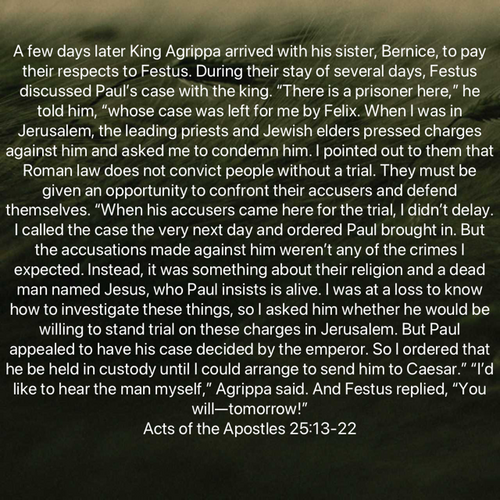
Once again, the value of Paul’s Roman citizenship was immeasurable. Without it, he would not have been able to appeal to Caesar. Otherwise, Paul would have been at the mercy of the local courts—in this case, Festus, who was inclined to send him back to Jerusalem to stand trial, where almost certain death awaited him along the way. I wonder if those guys who took an oath not to eat until Paul was dead were still around? It had been more than two years by this point, so I certainly hope they reconsidered that oath!
The Jews, as Festus himself states, wanted Paul condemned, yet even he was at a loss as to why, for Paul had done nothing deserving of death. King Agrippa and his sister Bernice, along with their sister Drusilla, who was married to the previous governor, Felix, came from a family well acquainted with Jewish affairs. Agrippa, in particular, was knowledgeable about Jewish customs and controversies, and obviously his curiosity was piqued when Festus told him about Paul. Festus, though politically motivated and wanting to keep favor with the Jews, at least recognized that Paul had done nothing deserving of death and was seeking counsel on how best to proceed with his case.
Yet all of this was in the plan of God. How many influential people had the opportunity to hear the Gospel message because of Paul’s imprisonment? Paul may have been imprisoned, but the message was not and was now being heard in the highest offices of the land. Paul would later write, “the word of God is not imprisoned” (2 Timothy 2:9 NASB 1995). Who better, other than the Lord Himself, to deliver the message than Paul? In fact, Paul serves as a valuable witness to the resurrection of the One who was really on trial—Jesus Christ. Paul was seemingly the defendant, but the real issue being examined was whether his testimony concerning the risen Christ was true.
It still amazes me how threatening the message of the cross was to the Jewish leaders of the day. Yet perhaps it shouldn’t surprise me, for these same kinds of animosities can exist even today among Christians, depending on what “denomination” one might be a part of. Sometimes we can become so confident in our own understanding of Scripture that we fail to recognize there may be things we have yet to learn, and yet Scripture reminds us that we ‘know in part’ (1 Corinthians 13:9). What that tells me is that there are things I still don’t know. Therefore, I should always have an open heart and be willing to have the Scriptures explained to me more accurately, just as Priscilla and Aquila pulled Apollos aside and explained the way of God to him more accurately (Acts 18:26). We must hold fast to what we know to be true while remaining humble enough to learn.
Unfortunately, the Jewish leaders had become so entrenched in their traditions that they seemed blind to the truth of the very Scriptures they had worked so hard to preserve—a truth that was now being displayed before them in the life of Jesus and subsequently through His disciples. They knew the Scriptures, yet when the One the Scriptures pointed to stood before them, many failed to recognize Him.
It is one thing to miss the boat ourselves and quite another to cause others to miss it as well. That should serve as a warning to all of us. Are there traditions, assumptions, or long-held interpretations that we defend so strongly that we become unwilling to allow Scripture to correct us? We must hold tightly to the truth God has revealed while remaining humble enough to acknowledge that we still “know in part.” May we never become so determined to defend what we have always believed that we fail to recognize what God is trying to show us through His Word.
The Jews, as Festus himself states, wanted Paul condemned, yet even he was at a loss as to why, for Paul had done nothing deserving of death. King Agrippa and his sister Bernice, along with their sister Drusilla, who was married to the previous governor, Felix, came from a family well acquainted with Jewish affairs. Agrippa, in particular, was knowledgeable about Jewish customs and controversies, and obviously his curiosity was piqued when Festus told him about Paul. Festus, though politically motivated and wanting to keep favor with the Jews, at least recognized that Paul had done nothing deserving of death and was seeking counsel on how best to proceed with his case.
Yet all of this was in the plan of God. How many influential people had the opportunity to hear the Gospel message because of Paul’s imprisonment? Paul may have been imprisoned, but the message was not and was now being heard in the highest offices of the land. Paul would later write, “the word of God is not imprisoned” (2 Timothy 2:9 NASB 1995). Who better, other than the Lord Himself, to deliver the message than Paul? In fact, Paul serves as a valuable witness to the resurrection of the One who was really on trial—Jesus Christ. Paul was seemingly the defendant, but the real issue being examined was whether his testimony concerning the risen Christ was true.
It still amazes me how threatening the message of the cross was to the Jewish leaders of the day. Yet perhaps it shouldn’t surprise me, for these same kinds of animosities can exist even today among Christians, depending on what “denomination” one might be a part of. Sometimes we can become so confident in our own understanding of Scripture that we fail to recognize there may be things we have yet to learn, and yet Scripture reminds us that we ‘know in part’ (1 Corinthians 13:9). What that tells me is that there are things I still don’t know. Therefore, I should always have an open heart and be willing to have the Scriptures explained to me more accurately, just as Priscilla and Aquila pulled Apollos aside and explained the way of God to him more accurately (Acts 18:26). We must hold fast to what we know to be true while remaining humble enough to learn.
Unfortunately, the Jewish leaders had become so entrenched in their traditions that they seemed blind to the truth of the very Scriptures they had worked so hard to preserve—a truth that was now being displayed before them in the life of Jesus and subsequently through His disciples. They knew the Scriptures, yet when the One the Scriptures pointed to stood before them, many failed to recognize Him.
It is one thing to miss the boat ourselves and quite another to cause others to miss it as well. That should serve as a warning to all of us. Are there traditions, assumptions, or long-held interpretations that we defend so strongly that we become unwilling to allow Scripture to correct us? We must hold tightly to the truth God has revealed while remaining humble enough to acknowledge that we still “know in part.” May we never become so determined to defend what we have always believed that we fail to recognize what God is trying to show us through His Word.
Recent
Archive
2026
January
Matthew 4:3-11John 1:32-34John 1:45-51John 2:6-11John 2:13-17John 2:18-25John 3:13-17John 3:18-21John 3:27-32, 36John 4:3-10John 4:11-15John 4:16-21John 4:22-26John 4:27-30John 4:31-38John 4:39-42John 4:46-53Mark 1:21-28Matthew 5:1-6Matthew 5:7-12Matthew 5:13-16Matthew 5:17-20Matthew 5:21-26Matthew 5:27-30Matthew 5:31-32
February
Matthew 5:33-37Matthew 5:38-42Matthew 5:43-48Matthew 6:1-4Matthew 6:5-13Matthew 6:14-18Matthew 6:19-21Matthew 6:22-23Matthew 6:24-30Matthew 6:31-34Matthew 7:1-5Matthew 7:6Matthew 7:7-11Matthew 7:12Matthew 7:13-14Matthew 7:15-20Matthew 7:21-23Matthew 7:24-29Matthew 8:1-4Matthew 8:5-12Matthew 8:14-17Matthew 8:18-22Matthew 8:23-27Matthew 8:28-34
March
Sunday 3-1-26Luke 7:11-17Mark 5:25-34Mark 5:22-42Matthew 10:1-8Matthew 10:38-40Matthew 11:28-30Matthew 12:33-37Matthew 12:46-50Matthew 10:10-13Mark 4:13-20Matthew 13:36-43Matthew 13:44-46Matthew 13:47-52Matthew 13:53-58Matthew 14:14-21Matthew 14:24-33Matthew 14:34-36John 6:29-35Matthew 5:1-9Matthew 15:10-20Matthew 15:21-28Matthew 15:29-31Matthew 15:32-39Matthew 17:14-20Hebrews 10:24-25Matthew 8:1-6Matthew18:18-20
Categories
no categories
No Comments