
Acts 24:1-9
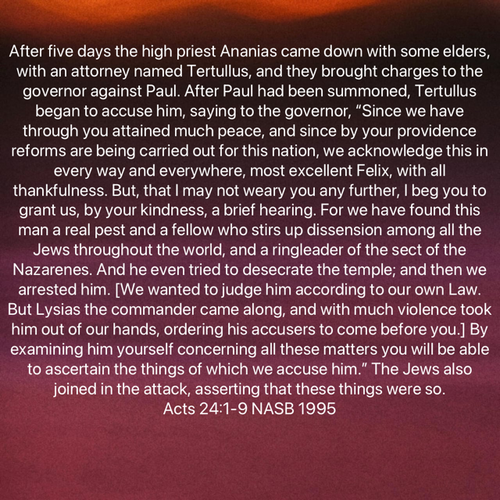
Five days later, the high priest and some of the Jewish elders arrived in Caesarea, along with a lawyer named Tertullus, to present their case against Paul. I am guessing they used at least some of those five days to come up with a strategy because Tertullus certainly came prepared.
It is interesting that they decided to throw Claudius Lysias, the Roman commander who saved Paul, under the bus by saying that he, “with much violence,” took Paul out of their hands. What Tertullus conveniently left out was the fact that they were the ones trying to kill Paul—a Roman citizen—without a trial. The commander simply removed Paul from their murderous hands. That was a rather significant detail to omit.
It is also curious to me that Tertullus accused Paul of stirring up dissension among the Jews throughout the world when, in fact, it was the Jews from the province of Asia who had stirred up the trouble in Jerusalem. They didn’t like what Paul stood for, so they falsely accused him and got the whole community riled up against him.
Why do we see this pattern time and time again? They said similar things about Jesus, and a quick browse through history shows that those desiring to bring positive change are often accused of stirring up trouble by those who resist that change. As I have heard it said, “When the argument is lost, people resort to violence.”
Thankfully, Paul had rights in this Roman proceeding as a Roman citizen—a pesky detail that the Jewish elders had to acknowledge and abide by. They had been ready to kill Paul without examining the facts of the matter, yet Paul’s citizenship afforded him the opportunity to have his day in court before Governor Felix and, eventually, to appeal his case to Caesar in Rome.
I believe we will see that Tertullus met his match in Paul, who was an excellent debater and conveyor of the truth. Tertullus may have sounded convincing in his opening argument, but now Paul would have the opportunity to answer the charges for himself.
As Proverbs 18:17 NLT states:
“The first to speak in court sounds right— until the cross-examination begins.”
Let the cross-examination begin...
It is interesting that they decided to throw Claudius Lysias, the Roman commander who saved Paul, under the bus by saying that he, “with much violence,” took Paul out of their hands. What Tertullus conveniently left out was the fact that they were the ones trying to kill Paul—a Roman citizen—without a trial. The commander simply removed Paul from their murderous hands. That was a rather significant detail to omit.
It is also curious to me that Tertullus accused Paul of stirring up dissension among the Jews throughout the world when, in fact, it was the Jews from the province of Asia who had stirred up the trouble in Jerusalem. They didn’t like what Paul stood for, so they falsely accused him and got the whole community riled up against him.
Why do we see this pattern time and time again? They said similar things about Jesus, and a quick browse through history shows that those desiring to bring positive change are often accused of stirring up trouble by those who resist that change. As I have heard it said, “When the argument is lost, people resort to violence.”
Thankfully, Paul had rights in this Roman proceeding as a Roman citizen—a pesky detail that the Jewish elders had to acknowledge and abide by. They had been ready to kill Paul without examining the facts of the matter, yet Paul’s citizenship afforded him the opportunity to have his day in court before Governor Felix and, eventually, to appeal his case to Caesar in Rome.
I believe we will see that Tertullus met his match in Paul, who was an excellent debater and conveyor of the truth. Tertullus may have sounded convincing in his opening argument, but now Paul would have the opportunity to answer the charges for himself.
As Proverbs 18:17 NLT states:
“The first to speak in court sounds right— until the cross-examination begins.”
Let the cross-examination begin...
Recent
Archive
2026
January
Matthew 4:3-11John 1:32-34John 1:45-51John 2:6-11John 2:13-17John 2:18-25John 3:13-17John 3:18-21John 3:27-32, 36John 4:3-10John 4:11-15John 4:16-21John 4:22-26John 4:27-30John 4:31-38John 4:39-42John 4:46-53Mark 1:21-28Matthew 5:1-6Matthew 5:7-12Matthew 5:13-16Matthew 5:17-20Matthew 5:21-26Matthew 5:27-30Matthew 5:31-32
February
Matthew 5:33-37Matthew 5:38-42Matthew 5:43-48Matthew 6:1-4Matthew 6:5-13Matthew 6:14-18Matthew 6:19-21Matthew 6:22-23Matthew 6:24-30Matthew 6:31-34Matthew 7:1-5Matthew 7:6Matthew 7:7-11Matthew 7:12Matthew 7:13-14Matthew 7:15-20Matthew 7:21-23Matthew 7:24-29Matthew 8:1-4Matthew 8:5-12Matthew 8:14-17Matthew 8:18-22Matthew 8:23-27Matthew 8:28-34
March
Sunday 3-1-26Luke 7:11-17Mark 5:25-34Mark 5:22-42Matthew 10:1-8Matthew 10:38-40Matthew 11:28-30Matthew 12:33-37Matthew 12:46-50Matthew 10:10-13Mark 4:13-20Matthew 13:36-43Matthew 13:44-46Matthew 13:47-52Matthew 13:53-58Matthew 14:14-21Matthew 14:24-33Matthew 14:34-36John 6:29-35Matthew 5:1-9Matthew 15:10-20Matthew 15:21-28Matthew 15:29-31Matthew 15:32-39Matthew 17:14-20Hebrews 10:24-25Matthew 8:1-6Matthew18:18-20
Categories
no categories
No Comments