Acts 23:1-6
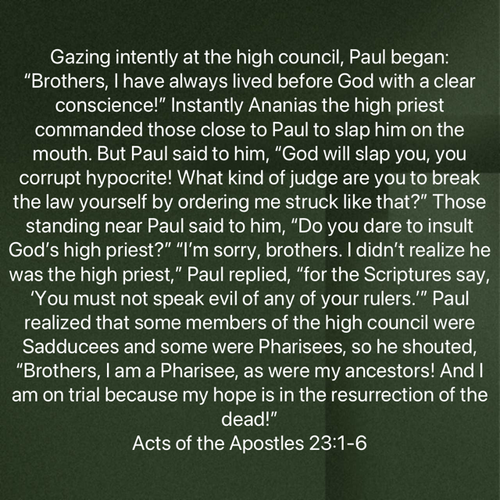
The end of Acts 22 closes with the commander of the Roman guard ordering the leading priests and the Jewish high council into session to find out what all the uproar was about. Paul begins his defense before the council by stating that he had lived before God with a clear conscience. The high priest took exception to Paul’s claim and ordered him to be struck in the mouth. We get a glimpse of Paul’s fiery personality in his response, calling the high priest a corrupt hypocrite—words he quickly took back upon learning that Ananias was the high priest.
It is not clear why Paul did not recognize Ananias as the high priest, but what we can glean from this exchange is Paul’s quick repentance upon learning who Ananias was and his willingness to submit himself to Scripture. Sometimes, even when someone else’s actions are wrong, it doesn’t give us license to do wrong in response. Ananias was breaking their own law by ordering Paul to be struck before he had even been found guilty, and Paul rightly called him out for it. However, Paul owned the name-calling and corrected himself when confronted with what Scripture said.
That is something we would all do well to remember. It is easy to justify a wrong response when we feel someone else started it. We may even be completely right about what they did, but being right about their behavior doesn’t necessarily make our response right. We all answer to the Highest Judge, and Jesus reminds us that we will give an account for every idle word we speak. Our responsibility is to hold up the standard of truth, allowing each person, ourselves included, to examine their own heart in its light.
Paul then takes a quick survey of the room and recognizes his mixed audience—Pharisees and Sadducees. He immediately uses that to his advantage by revealing his heritage as a Pharisee and explaining that he was on trial because of his hope in the resurrection of the dead. That started a firestorm among the council because, while the Pharisees believed in the resurrection and in angels and spirits, the Sadducees did not.
Basically, Paul got them arguing among themselves, shifting the focus from him to a theological disagreement that was already simmering beneath the surface. As we will see, the situation gets out of hand quickly, and once again the Roman guard will have to step in.
It is not clear why Paul did not recognize Ananias as the high priest, but what we can glean from this exchange is Paul’s quick repentance upon learning who Ananias was and his willingness to submit himself to Scripture. Sometimes, even when someone else’s actions are wrong, it doesn’t give us license to do wrong in response. Ananias was breaking their own law by ordering Paul to be struck before he had even been found guilty, and Paul rightly called him out for it. However, Paul owned the name-calling and corrected himself when confronted with what Scripture said.
That is something we would all do well to remember. It is easy to justify a wrong response when we feel someone else started it. We may even be completely right about what they did, but being right about their behavior doesn’t necessarily make our response right. We all answer to the Highest Judge, and Jesus reminds us that we will give an account for every idle word we speak. Our responsibility is to hold up the standard of truth, allowing each person, ourselves included, to examine their own heart in its light.
Paul then takes a quick survey of the room and recognizes his mixed audience—Pharisees and Sadducees. He immediately uses that to his advantage by revealing his heritage as a Pharisee and explaining that he was on trial because of his hope in the resurrection of the dead. That started a firestorm among the council because, while the Pharisees believed in the resurrection and in angels and spirits, the Sadducees did not.
Basically, Paul got them arguing among themselves, shifting the focus from him to a theological disagreement that was already simmering beneath the surface. As we will see, the situation gets out of hand quickly, and once again the Roman guard will have to step in.
Recent
Archive
2026
January
Matthew 4:3-11John 1:32-34John 1:45-51John 2:6-11John 2:13-17John 2:18-25John 3:13-17John 3:18-21John 3:27-32, 36John 4:3-10John 4:11-15John 4:16-21John 4:22-26John 4:27-30John 4:31-38John 4:39-42John 4:46-53Mark 1:21-28Matthew 5:1-6Matthew 5:7-12Matthew 5:13-16Matthew 5:17-20Matthew 5:21-26Matthew 5:27-30Matthew 5:31-32
February
Matthew 5:33-37Matthew 5:38-42Matthew 5:43-48Matthew 6:1-4Matthew 6:5-13Matthew 6:14-18Matthew 6:19-21Matthew 6:22-23Matthew 6:24-30Matthew 6:31-34Matthew 7:1-5Matthew 7:6Matthew 7:7-11Matthew 7:12Matthew 7:13-14Matthew 7:15-20Matthew 7:21-23Matthew 7:24-29Matthew 8:1-4Matthew 8:5-12Matthew 8:14-17Matthew 8:18-22Matthew 8:23-27Matthew 8:28-34
March
Sunday 3-1-26Luke 7:11-17Mark 5:25-34Mark 5:22-42Matthew 10:1-8Matthew 10:38-40Matthew 11:28-30Matthew 12:33-37Matthew 12:46-50Matthew 10:10-13Mark 4:13-20Matthew 13:36-43Matthew 13:44-46Matthew 13:47-52Matthew 13:53-58Matthew 14:14-21Matthew 14:24-33Matthew 14:34-36John 6:29-35Matthew 5:1-9Matthew 15:10-20Matthew 15:21-28Matthew 15:29-31Matthew 15:32-39Matthew 17:14-20Hebrews 10:24-25Matthew 8:1-6Matthew18:18-20
Categories
no categories
No Comments